
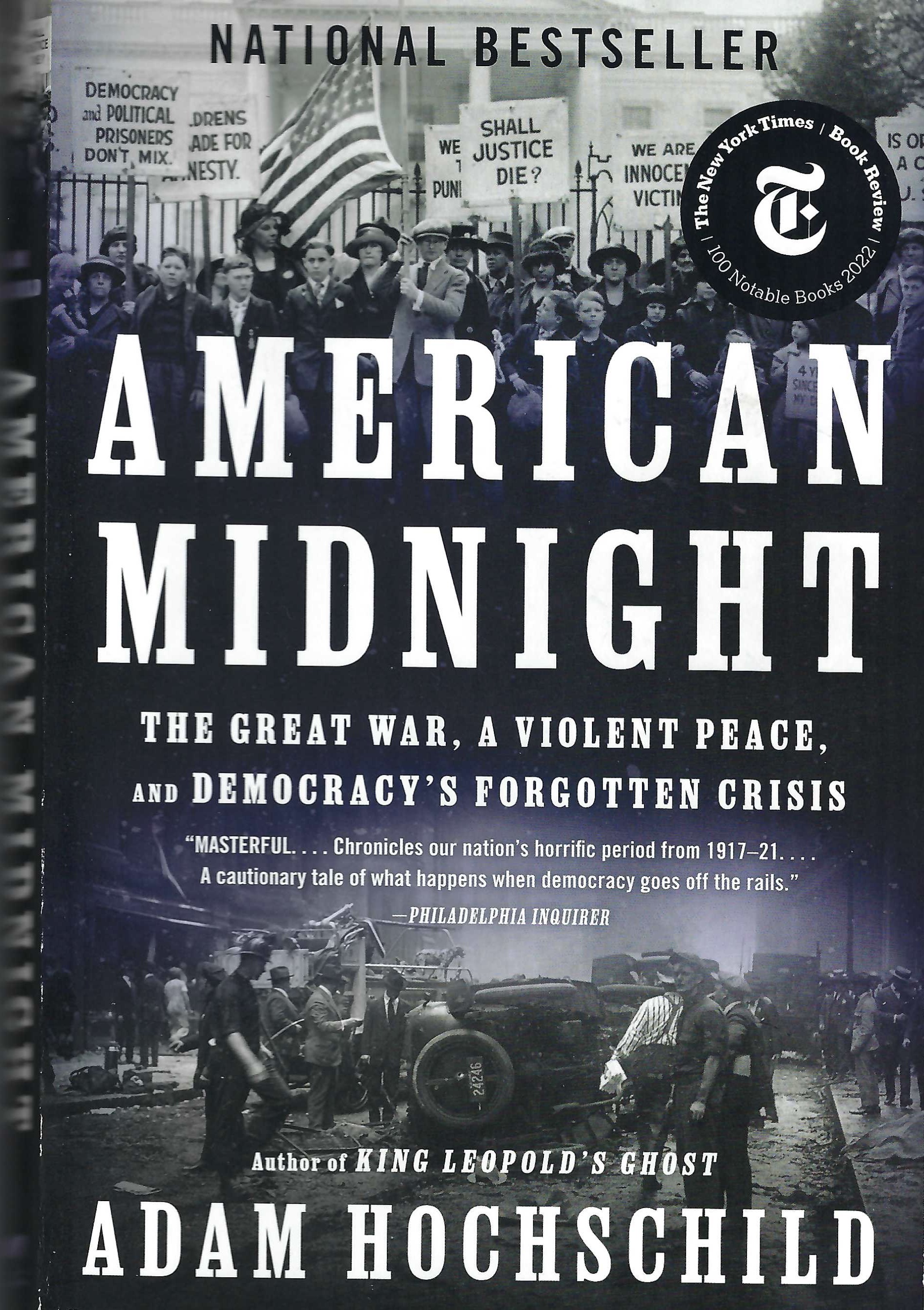
Thanks to a recommendation from a high-school classmate (Hooray to the Liberty Center Class of 1966!), I read “American Midnight” by Adam Hochschild, a book that foreshadows what is going on in the world today. Some of what Hochschild wrote seems worth passing on:
On truth and falsehood:
“Honesty was not high on the CPI agenda. One of its architects, the journalist Arthur Bullard, had written, with revealing candor, ‘Truth and Falsehood are arbitrary terms . . . There is nothing in experience to tell us that one is always preferable to the other . . . The force of an idea lies in its inspirational value. It matters very little whether it is true or false.’”
The CPI was the Committee on Public Information, something formed by President Woodrow Wilson to sell the idea of the United States entering World War I. The chief of CPI, George Creel, a former newspaperman, said, “If ads could sell face cream and soap, why not a war?”
(Editor’s note: Bullard and Creel represent what happens when journalists go over to the dark side, selling things instead of telling the truth.)
Later in the book, Hochschild quotes from a dissenting opinion by Supreme Court Justice Oliver Wendell Holmes:
“. . . that the ultimate good desired is better reached by free trade in ideas – that the best test of truth is the power of the thought to get itself accepted in the competition of the market . . . We should be eternally vigilant against the attempts to check the expression of opinions that we loathe.”
Key to politics:
Hochschild quotes John Maynard Keynes on this:
“A moment often arrives when substantial victory is yours if by some slight appearance of a concession you can save the face of the opposition.”
Keynes found Wilson incompetent in this regard. Is “doubling down” by Trump any better?
Immigrants:
Hochschild quotes General Leonard Wood, who was brought in to end a steel workers’ strike, which Wood blamed on foreigners:
“The great need is keeping this kind of cattle out of the country and getting those who are here out of it . . . Every man of this type ought to be summarily deported.”
Then Hochschild turns to Washington State’s very own congressman, Albert Johnson, who had attained chair of the House Committee on Immigration and Naturalization:
“Offering no evidence but pandering to an enduring streak of American paranoia, he claimed wildly that ‘aliens were being smuggled across the Mexican border at a rate of 100 a day, a large part of them being Russian Reds who had reached Mexico in Japanese vessels.’”
One more quote on immigrants comes from Francis Fisher Kane, a United States attorney in Philadelphia, who resigned after immigrant raids:
“It is one thing to debar an alien coming into this country . . . but it is quite another thing to deprive a man who has been in this country a long time, and who perhaps has a wife and children here, of what we are accustomed to think of as constitutional rights, irrespective of a man’s citizenship.”
College professors:
No matter where you stand on opinions you loathe or on Truth or Falsehoods, this quote, especially the part about modern college professors, is true, true, true. I’m basing that on my time as an adjunct professor at four institutes of higher learning:
Woodrow Wilson “had spent decades as a college professor – in an age when someone in that role was not a performer struggling to draw students’ attention away from their cell phones, but a source of moral authority, like a member of the clergy.”

Interview with the author:
Jennifer Rubin, no longer a columnist with The Washington Post, interviews Adam Hochschild on The Contrarian, her new digs: