The Senate has unanimously passed the EXPLORE Act, which is now headed to President Biden’s desk for signing. The House passed it in April. As this article points out, the bill includes the Biking on Long Distance Trails Act (BOLT) to identify and create more long-distance bike trails, the Protecting America’s Rock Climbing Act (PARC) to safeguard Wilderness climbing, the Simplifying Outdoor Access for Recreation Act (SOAR) that will improve recreational permitting for outfitters and guides, and permanent direction for the Outdoor Recreation Legacy Partnership and FICOR.
Never saw the passage of this bill coming, But glad it is becoming law before January 20, 2025.
After five days of Utah bike riding with my sister and family, Kathy and I went south while the rest headed back to Salt Lake City. The two of us landed on the North Rim of the Grand Canyon, peering down into the Colorado River, where we rafted last fall.
You can’t see the river from where we were on the North Rim, but the views were magnificent. We had a cabin on the rim at the end of the line; no other cabin crowding us on one side.
I spent a lot of time with feet up, gazing down into the canyon.
Speaking of gazing, don’t miss the Star Party that happens on the verandah of the Grand Canyon Lodge. The signs advertising it says it starts at 7:30 p.m. Maybe for other times of the year, but we were there when it did not get dark until after 9 p.m. In the darkness, we stumbled through many telescopes set up on the verandah until we found a telescope that had no opening to look through. Instead, it streamed a picture of the sky every 10 seconds, progressively showing the stars that came out as the night went on. The operator Air Drop’d one of the photos onto our cell phones. The focus in the middle of the photo is a galaxy, which I cannot name or remember. Let’s just say it is a Galaxy Far, Far Away.
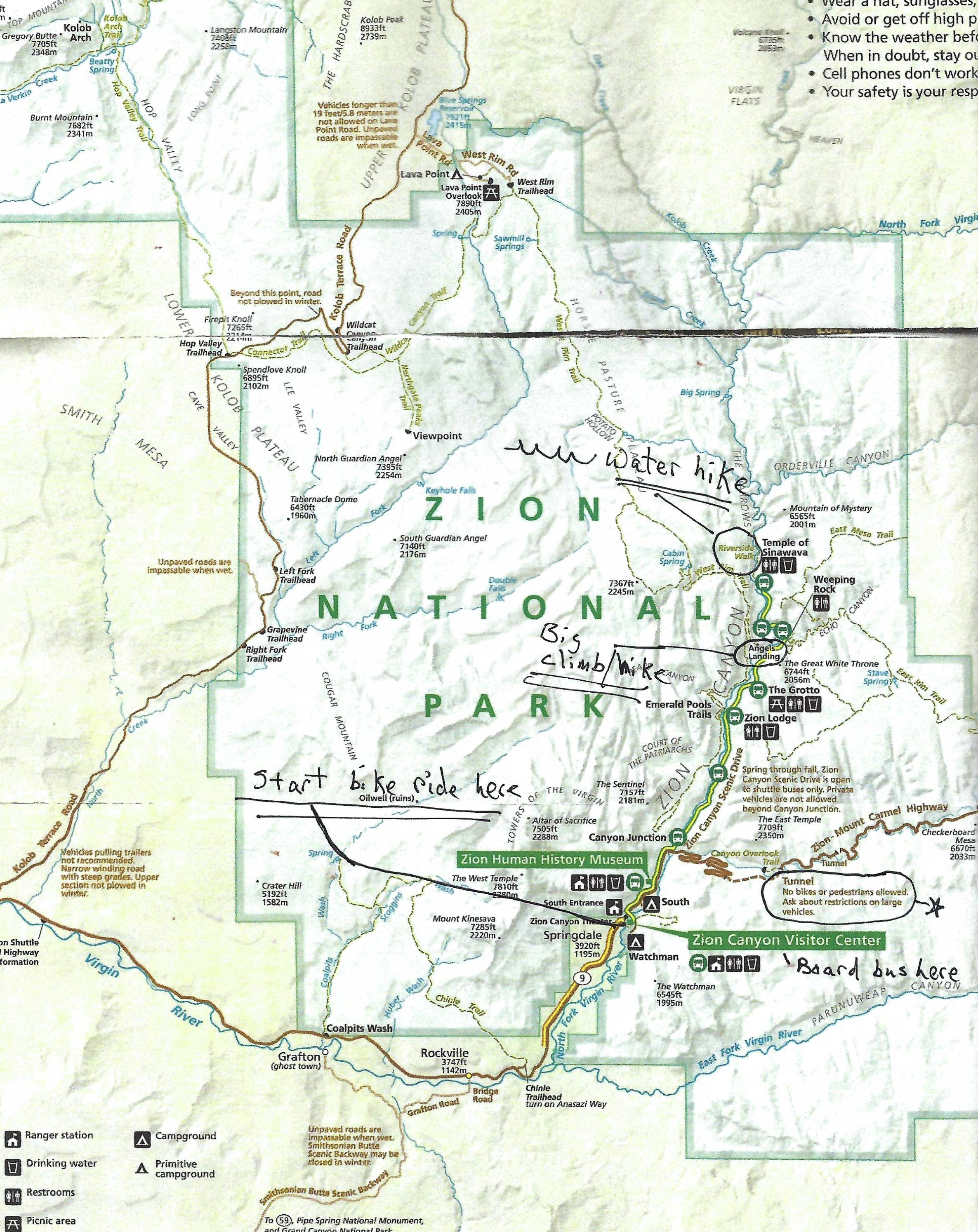
Bicycles are not allowed in the tunnel on the Zion-Mount Carmel Highway, but there is a fine place for bike riders in the Zion National Park: A paved highway with no cars allowed. The only motorized vehicle bike riders will see are buses bringing in hundreds of tourists who may hop out to hike on various trails or just sit back in their bus seat and make that their visit to the park.
Here are the rules for the buses and bicycles: Bikes can’t pass buses. A bus will pass bicycles when the rider has stopped and has his or her feet on the ground, which is required when a bus is behind you. (I only saw one pair of riders who did not follow this rule, maybe unaware of it or pursuing that day’s yellow jersey.)
We rode to the end of the road and the Temple of Sinawava trail, turned around and rode back for a pleasant 16-mile ride with no traffic on a flat paved road.
That was not enough daily exercise for this group. After changing clothes, we got in the long coiled snake of a line to get on the buses heading to the Temple of Sinawava. Many people on our crowded bus carried long wooden poles and wore black and orange shoes with gaskets around the ankles. What was that all about?
A very crowded trail
I did not find out until we got to the terrestrial ends of the Temple of Sinawava trail. That’s where the aquatic portion of the trail begins; the shoes to keep feet dry and the poles to help prevent falling as you wade up through the Narrows in the Virgin River.
The trail, both on land and sea, was crowded the day we were there, as, I bet, it is every day of the summer months. We could have avoided those crowds by getting off the bus at the start of the trail to Angels Landing. That would entail 22 switchbacks and chains to grip so you did not make a landing of your own. Anne had done the hike/climb, but it looked like I showed up 50 years too late to take this one on.
This is the way to ride Bryce Canyon National Park: Put your bikes on the back of the truck and drive it to Yovimpa Point, the end of the road. There you can hike on several trails: Riggs Spring Loop Trail, Under the Rim Trail (that looks the longest) or Bristlecone Loop Trail (appears to be the shortest).
Or, you can set your bike back on the road and cruise downhill for 18 miles. The High Plains Drifter, for sure. What a downhill ride! Brakes? What brakes? I did have to slow down when I turned off on the trail at Inspiration Point. All those curves to negotiate and kids to avoid. Still made it to Ruby’s Inn a half hour before the others.
Then it was out of the park and onto a bike trail that ran along Route 12 but did venture into the woods along the way to Red Canyon where we met up with The Spouses, our excellent SAG crew.
Bikes loaded, we were off to Zion National Park, where bicycling is not allowed in the Zion-Mount Carmel Tunnel that leads to the main part of the park. Until 2026, larger vehicles – RVs, trailers, etc. – can pay a $15 charge and go through the tunnel during hours when rangers are there to orchestrate alternating one-way traffic. After 2026, larger vehicles will have to find another way into the park. The National Park Service posted this on May 30, 2024:
“Beginning in mid-2026, the park plans to reroute vehicles that exceed 11’4” tall, 7’10” wide, 35’9” long, or 50,000 pounds to routes other than the Zion-Mt. Carmel Highway (the road across Zion National Park). Vehicles that exceed these specifications can use existing alternate routes surrounding the park.”
Maybe that will make room for bicycles.
Bikes are loaded on the trucks, and we are waiting our turn for the one-way traffic through the Zion-Mount Carmel Tunnel
Day 3, Boulder, Utah, to a wide spot in the road: We faced two of the three Hs in the H-E-double LL of bike touring: Hills and head winds. Fortunately, Heat left us pretty much alone. We made 48.7 miles of the planned 66 miles.
We started with a climb up to the Hogsback, a great downhill ride with drop offs on both sides of the road, curves and lots of speed if you chose it, which I did. Another sonic boom, I’m sure.
The drop off on these shoulders is hundreds of feet
Onward to the town of Escalante, Utah, for a Gatorade and potato chip break. Anne warned us that the long downhill we had just experienced would be met with the eventual long uphill. But she forgot to mention the head winds.
More uphill
Three of us have electric-assisted bikes, and the miles they can cover on one charge is more dependent on elevation than mileage. They fell short today. My bike was down to one red bar, which doesn’t translate into anything until it starts blinking. Then it’s time to hurry to the end. My sister’s new bike said she had five miles before she was on her own, falling well short of the planned 66 miles and Tropic, Utah, and the pizza joint there, which turned out to be closed. Some wise person pulled over to a wide spot in the road and declared today’s ride over. We called in the SAG trucks, who carried us to Bryce Canyon National Park. Hooray for The Spouses!
“Pleasant” is not the usual word I have used to describe previous bike rides in this blog, but our recent ride in Utah was very pleasant. Organized by Jason, our niece/nephew in law, who plotted the course, found the hotels to stay in and chose restaurants to eat in. The four bike riders had wonderful SAG support, AKA “The Spouses” or Don and Kathy.
After five days of riding, Kathy and I split off to visit National Parks while the rest of the family returned to Salt Lake City. More on those National Parks in a future post, but first, the bike ride:
Fish Lake to Capital Reef Lodge, near Torrey, Utah. When I finished riding the 40-mile route, I looked at my odometer to see how long it took: 2.5 hours. Impossible. With my usual pace – even with my electric-assisted bike – of 10 miles per hour, this could not be. But lots of long, downhill coasting shortened today’s ride. My sister, who has now ridden in all lower 48 states and is migrating to Canada routes this summer, called it “the fastest I have ever ridden 40 miles.” Three of us have electric assisted bikes, and Anne, our niece, has no need for any assistance to stay up front of the pack.
Coming down the hill from Fish Lake
A quick ride tomorrow? Probably not. Jason warned us that we climb 3700 feet before the downhill into Boulder, Utah.
Torrey to Boulder, Utah: Jason was right. It was a day of climbing, up to 9,600 feet of elevation, and Jason forgot to supply oxygen bottles. But soon after that, a downhill stretch of almost 10 miles. My odometer does not record the top speed reached during a ride, a big disappointment on a day like this one where I may have broken the sound barrier. Six and eight percent downhill grades will do that.
On the long, slow way up, I kicked my electric assist up to “turbo,” the top end assistance (eco, touring and turbo) on one of the steeper hills, my first venture into turbo flight. I pedaled a few times, and the assist stopped assisting. Off my bike to investigate when engineer Anne, who the night before had passed a test online to earn her Arctic engineering credentials for Alaska, came by and prescribed the highly technical way to repair the assist: Turn it off. Turn it on. Off. On. Then it worked fine. A mystery to me for why it stopped. Shorted out? Overheated? A climb to far for Reddy Kilowatt? Thank heavens he came back to help as it would have been an unpleasant hill for me.
After the ride, I took a nap, but Kathy went off to visit a slot canyon,
March and April in Egypt and then May and June in Japan. 2023 was not meant to be this way, but COVID is to blame — and will be blamed for another trip in September. So I interrupt what I wanted to say about Egypt and Ramses II with a little bit about our trip to Japan with a grandson (his high-school graduation present three years late).
Of the 130 million people living in Japan, 33 million of them live in the Tokyo area, which makes for some crowded streets. What it does not mean are litter, graffiti and people living on the streets — or at least not to what we saw in our two weeks visiting Japan. We did not look under every freeway pass or in every park where the unhoused people live in Seattle, but we only saw one or two people sleeping on the pavement.
Trash? Concentrated hunt for it. Two smashed beverage cans on day 1 during our eight-mile walk through the city. Day 2: Candy wrappers here and there occasionally but a spotty coverage at best. And there are very few trash cans on the streets. What do people do with their litter? Take it home with them?
But the most remarkable thing I saw on the streets of Tokyo — besides the rivers of people — were bicycles without locks. That can’t be in a big city like this, I thought. A closer inspection showed that yes, there were bikes unlocked, but many had a small ring locked around the back tire. Try to hop on and ride away? You’d be straddling the crossbar in seconds, and it would serve you right. No cycle stands to clog up the sidewalks. Bikes pulled off to the side with only a tiny ring to stop the bike thieves in Japan. Would that work in Seattle, in the United States of America? Hell no. Thieves here would drive around in a semi loading bike after bike until they spilled out the top as the truck drove to the hidden chop shop (once the former Seattle Times building) to cut through the tiny rings, leaving the former owner to buy another bike.
We interrupt my travelogue through Egypt for a bike trip across the state of Arkansas.
Why Arkansas? Because my sister has ridden across all the lower 48 states except two: Arkansas and Utah. Now she is down to one: Utah, where I have promised to be the Supplies And Gear (SAG) person because I cannot keep up with her.
There, I have said it. No more sibling rivalry. I have surrendered. I will forever be a half mile behind her — or more.
We started this ride in Fort Smith, Arkansas, right on the Oklahoma border and the Arkansas River, headed to the Mississippi River and Memphis, some 300 miles away by Mary Jo’s route.
Day One: The weather was chilly but clear. My new electric-assisted bike was working fine. It was Sunday morning, and the traffic was light. And for once in my rides with my sister, I cannot be blamed for cutting short the day’s ride. That blame goes to a nail that found itself lodged in Mary Jo’stire somewhere near Midway, AR. We were 54 miles into a 77-mile ride when Mary Jo stopped, walked up to me and announced she had a flat tire. “Front or rear?” Rear. Ugh.
We decided to call the SAG team, otherwise known as our spouses. MJ spouse Don arrived for the rescue, and after a Mexican lunch at our first overnight stop in the town of Dardanelle, three of us spent more than an hour changing the tire.
If it hadn’t been for that nail, I might have shortened the ride.Somewhere in those 54 miles, I discovered that the auxiliary battery I bought to make sure I could make the average of 80 miles a day was not charged. So soon after those 54 miles, my bike would have been without power, and it would have been up to my two legs alone to get us to Dardanelle. The SAG team does not answer the phone on those calls.
After the tire repair, I examined my batteries, found the right slots for the charging tabs to go into and set them up for overnight.
The view from our breakfast table at Mather Lodge. The cliffs across the valley remind me of those along the Buffalo River in Arkansas.
Day Two: We rode 20 miles on a foggy morning before stopping for breakfast at the Mather Lodge in Petit Jean State Park. I’d go back to Arkansas just to stay at the lodge. The website says that the “native log and stone facilities (were) constructed by the Civilian Conservation Corps (CCC) beginning in 1933. The CCC built trails, roads, bridges, cabins, and the focal point of the park, historic Mather Lodge, a 24-room lodge overlooking Cedar Creek Canyon with a restaurant, meeting rooms, and gift shop.”
The story behind why the park is called Petit Jean is a charming — but sad — one. I hope you can enlarge and read it on the menu page I photographed.
Concerned about whether my bike and batteries would last the 90 miles for the day, I did lots of coasting to reserve battery power. Coasting downhill is the only time I can get ahead of my sister, who holds back on the descending grades. So somewhere on Arkansas Route 300, I got way ahead of her, so far ahead that I missed a turn. At the bottom of the hill, Mary Jo told me I had missed it and we had to ride back a mile, adding two miles to the day’s ride. Maybe because of coasting or maybe because the batteries have more juice than I thought, I made the 90-mile ride to Little Rock with power to spare. And I was feeling pretty good about staying less than a half mile behind my sister, until after dinner when she acknowledged that her electric-assisted bike had run out of power. At what point in the ride? About 75 miles, which means that she rode the last 15 miles on her own power. The ego balloon popped.
Day Three: I was slow. I do not like riding in the rain, which started before we got outside the city limits of Little Rock. It rained until we arrived at England, AR, 37 miles into the ride. The only good thing I can say is that Mary Jo’s route had us on beautiful roads: Hardly any traffic, smooth pavements, trees along the route. Besides being a great bike rider, my sister is also a pretty good navigator. She has to stop along the way to dig out her reading glasses to study her Garmin, her written route in a rain-proof folder and check her cell phone if there is coverage. Even when I think she has led us astray, I follow. We turn onto a road that says “No Outlet,” I’m riding behind her (a half mile back). “Road closed”? Who cares? There will be a trail at the end of it. Or a way through a construction zone, as happened in the photo below. “Sometimes it works, sometimes not,” Mary Jo said. “This time, it worked.”
I also do not like riding in the wind, which I thought came up after the rain even though my sister said, “This is not too bad.” So I was slow. So slow that at 64 miles, we called in the SAG team 13 miles short, realizing that getting to Clarendon, AR, before dark could be a problem.
In my defense, I would like to point out that walking 1.8 miles across the heaped-stone gravel “shortcut,” did not help our time. Still some work to do on navigation, sis.
Day four: It rained all night and into the morning. Rained hard. Enough that we walked to breakfast and decided to drive with the SAG team to Marianna, AR, ahead of the rain.
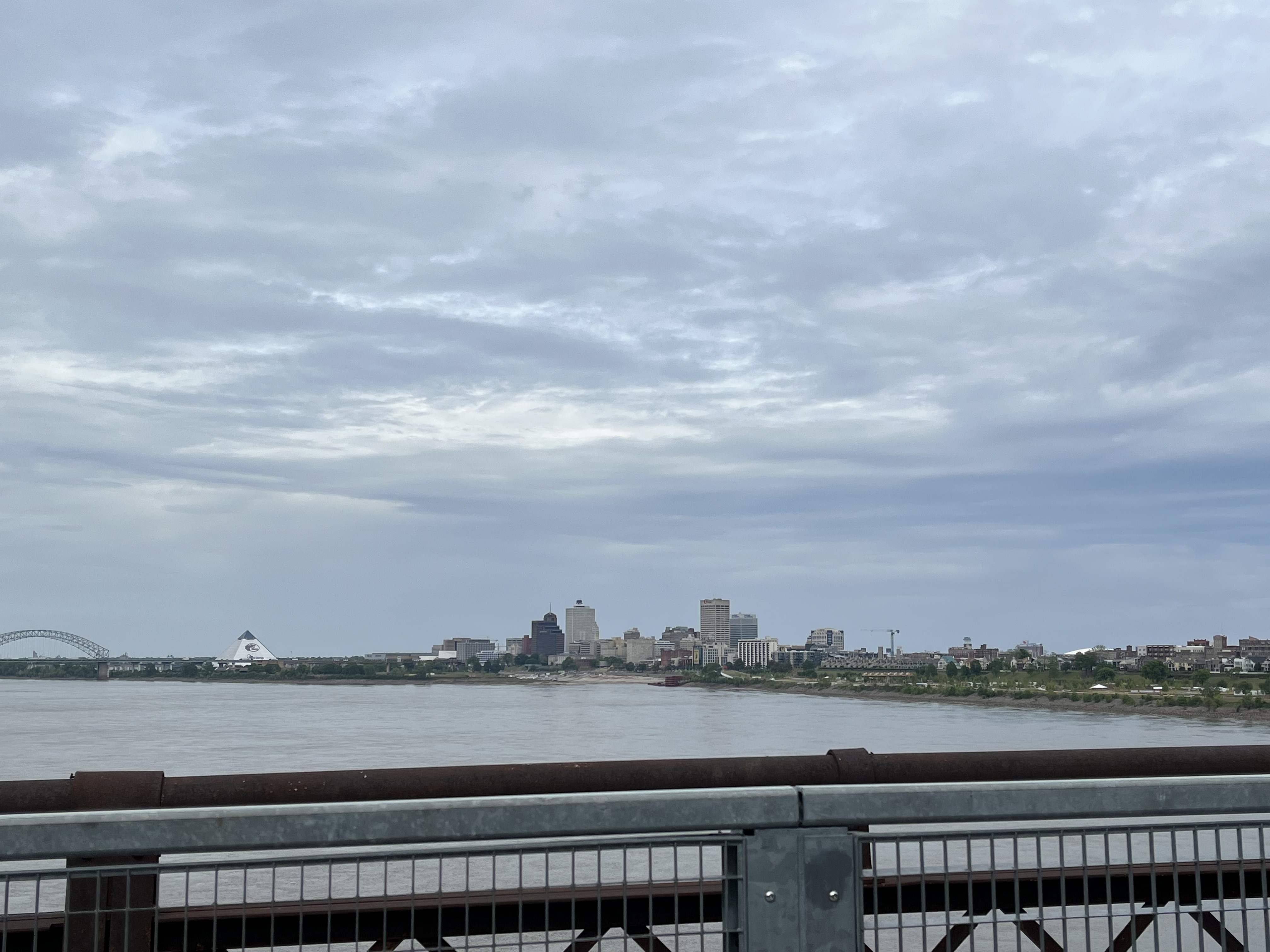
We kept dry for 60 miles into Memphis, TN, but were disappointed in the Mississippi River Levee because you can’t see the river from on top of the embankment, which is covered with crumbly gravel.
The Big River Trail was an assortment of trails, roads and turns, one of which I slipped in gravel and came down hard on my side. Two miles from the end of the ride — but better than two miles at the start of the ride, as Josh at the bike shop pointed out.
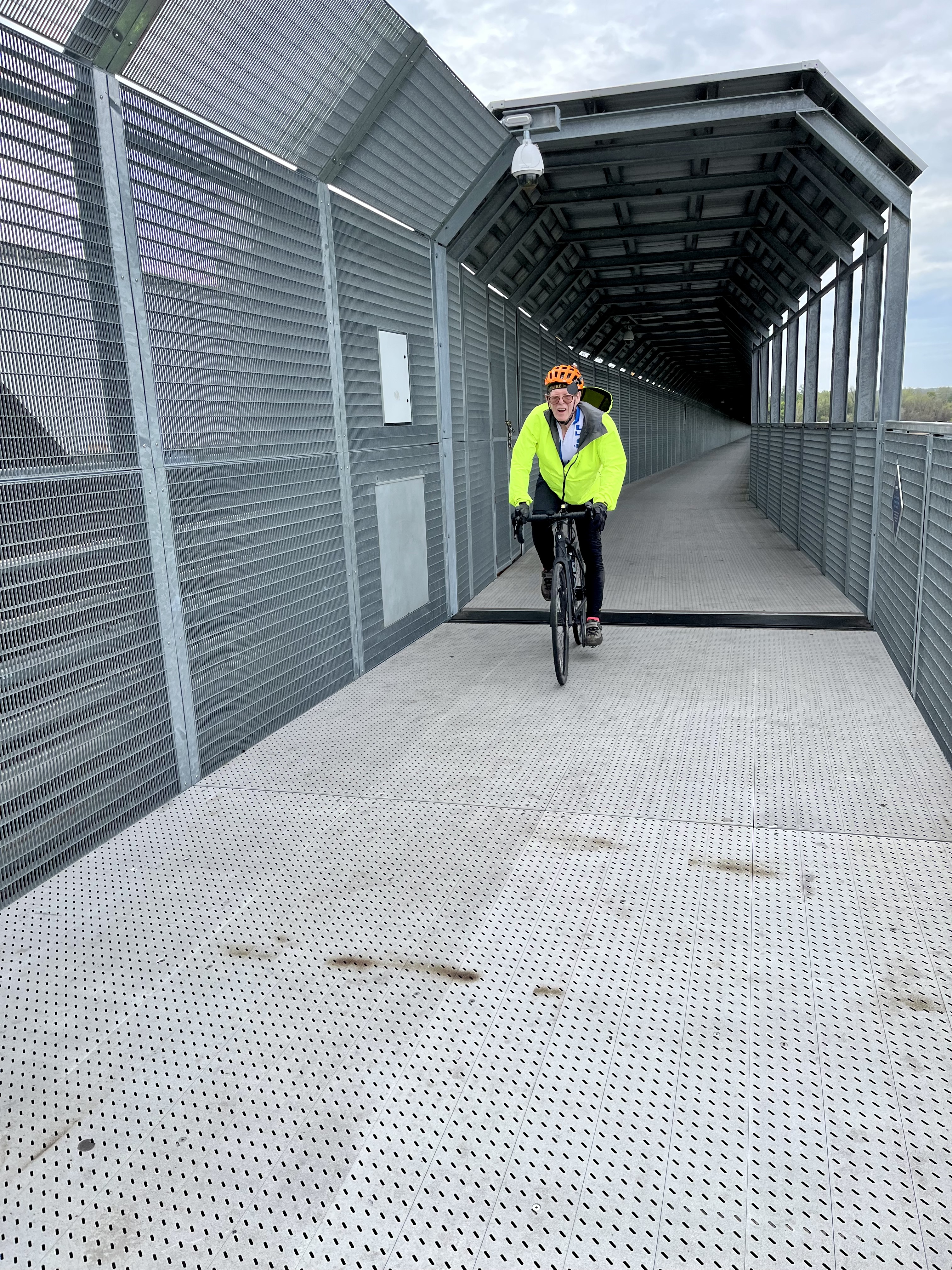
The bike lane across the Mississippi River is on a converted railroad bridge, fenced in with very few people on it the day we came across.
Despite the flat tire, the rain and my fall, we made it across Arkansas. When the woman at the bike shop, which is shipping my bike back to Seattle, heard about our journey, she said: “It was an eventful ride.”
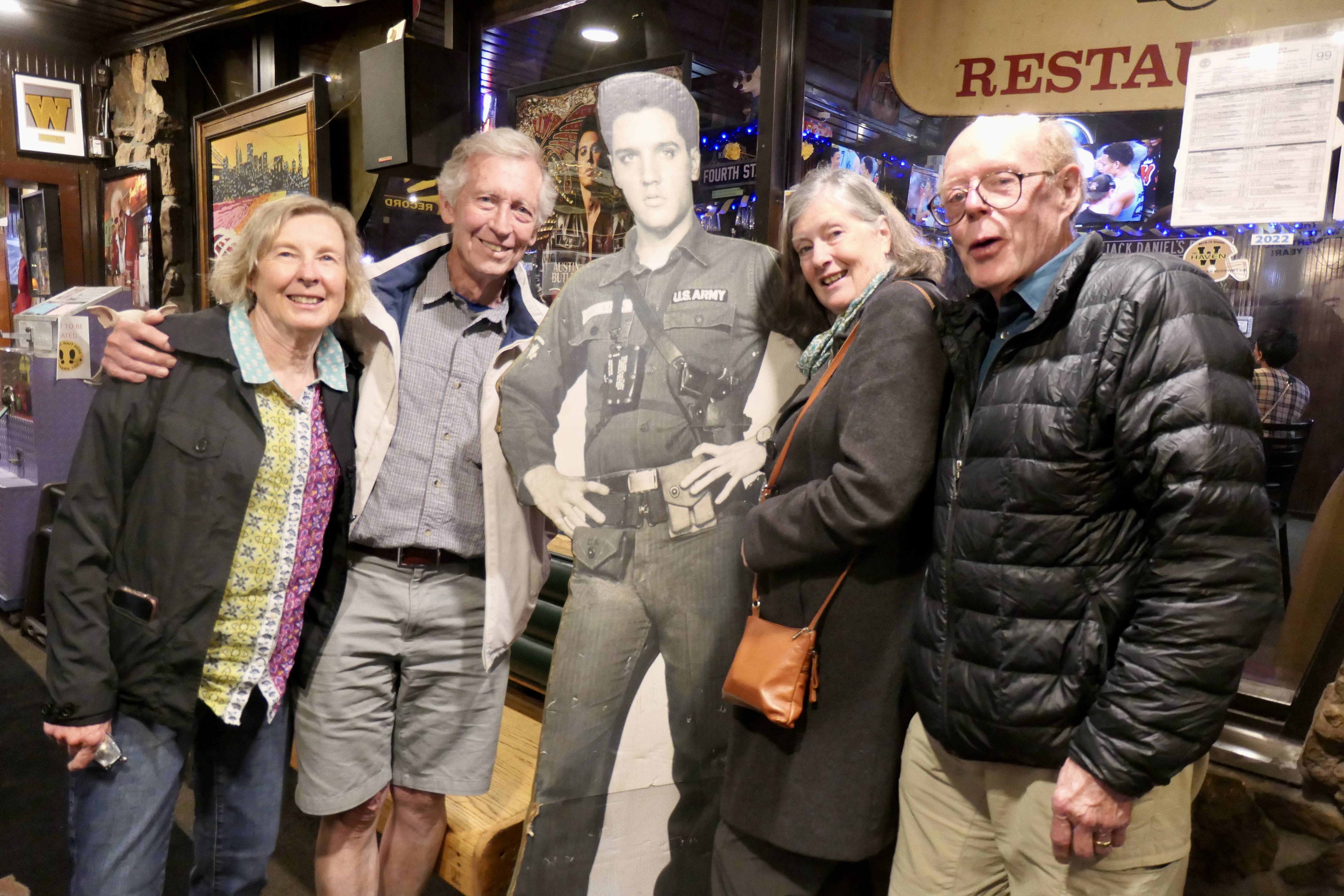
And we ended it all with a ride in a pink Cadillac limo to a dinner with Elvis at the Marlowe Restaurant (order the ribs).
It’s electric-assisted, goes 50 to 60 miles on a single charge and I can lift it. Another Trek — Domane+ AL5.
But I’m afraid to ride it anywhere — at least anywhere where it might get stolen, as my last bike was. So I ride it when I know I will not get off of it or if I know there is a bike rack I can chain it to. Which leaves out Edmonds College.
Not that chains do much good. I picked out a complicated bike lock, sections of steel that fold up into something I can carry on the bike. That might be enough weight that I cannot do what I am doing in the photo above. The bike locks at the store ranged from cables a Chihuahua could bite through to chains heavy enough to drag Marley to the ground, and way too expensive for Scrooge to buy. Andy, who was a great help, said that professional bike thieves (there are such people?) carry all the tools they need to cut through anything.
Here is a wonderful bike that I had for almost two years before it was stolen on Tuesday. I rode it to a class on Shakespeare’s Sonnets at Edmonds College, part of its Creative Retirement Institute. Seven mile ride up, enrich my mind and seven miles back home, build my body. Wore my new Gorewear jacket that Kathy gave me for Christmas, a lime green so bright it scares scurvy away.
There was no bike rack at the classroom building so I used my wimpy chain to tether the bike to a telephone pole along a major street.
The clock on the classroom wall displayed 1:04 when I entered. Late because I, of course, got lost. At break just before 2 p.m., I walked out to get a drink from my water bottle — and the bike, water bottle, Timbuc2 carrying case, headlight, tail light and any faith I had in humanity were gone.
Among our family (three of us), that makes four bikes stolen. I don’t have pictures of the previous hijacked bicycles as I was not as deeply in love with them as I am now. And, they did not cost as much as the bike above did. But I remember them:
The Crescent: Bought when I worked at The Columbian in Vancouver, WA. I went looking for it on Google, and lo and behold, here is my bike, or at least one in orange that looks like it came right out of my garage here in Seattle in about 1979 or 1980. Sorry I can’t find the URL for this image, but you might check here if you are in line for a vintage bike.
Next came Kathy’sSekai, that left the garage with the Crescent. Kathy might have become a cyclist if that thief had not interfered. But we did learn to keep the garage door shut.
Left unchained in front of a Seven-11 by someone who will not be named, the Kobe left the parking lot and never turned back despite the owner running after it and its rider.
Here is a piece worth reading on Japanese bikes. And since I stole this image from Classic Cycle Bainbridge Island, I should put in a plug for them. This place looks like it would be worth a ride to see — if I had a bike.
But it is only a mile from the ferry dock, a 20-minute walk and the weather on Sunday is forecast to be sunny. I could visit to buy a new bike to replace the No. 4 bike stolen from us, a Trek Checkpoint ALR4.
Or I could watch the Benegals football game and make this a stop on the upcoming Chilly Hilly — if I had a bike.
And as for bike thieves, Shakespeare had this to say: