Utah bike ride, Day 5 — and a hike, too

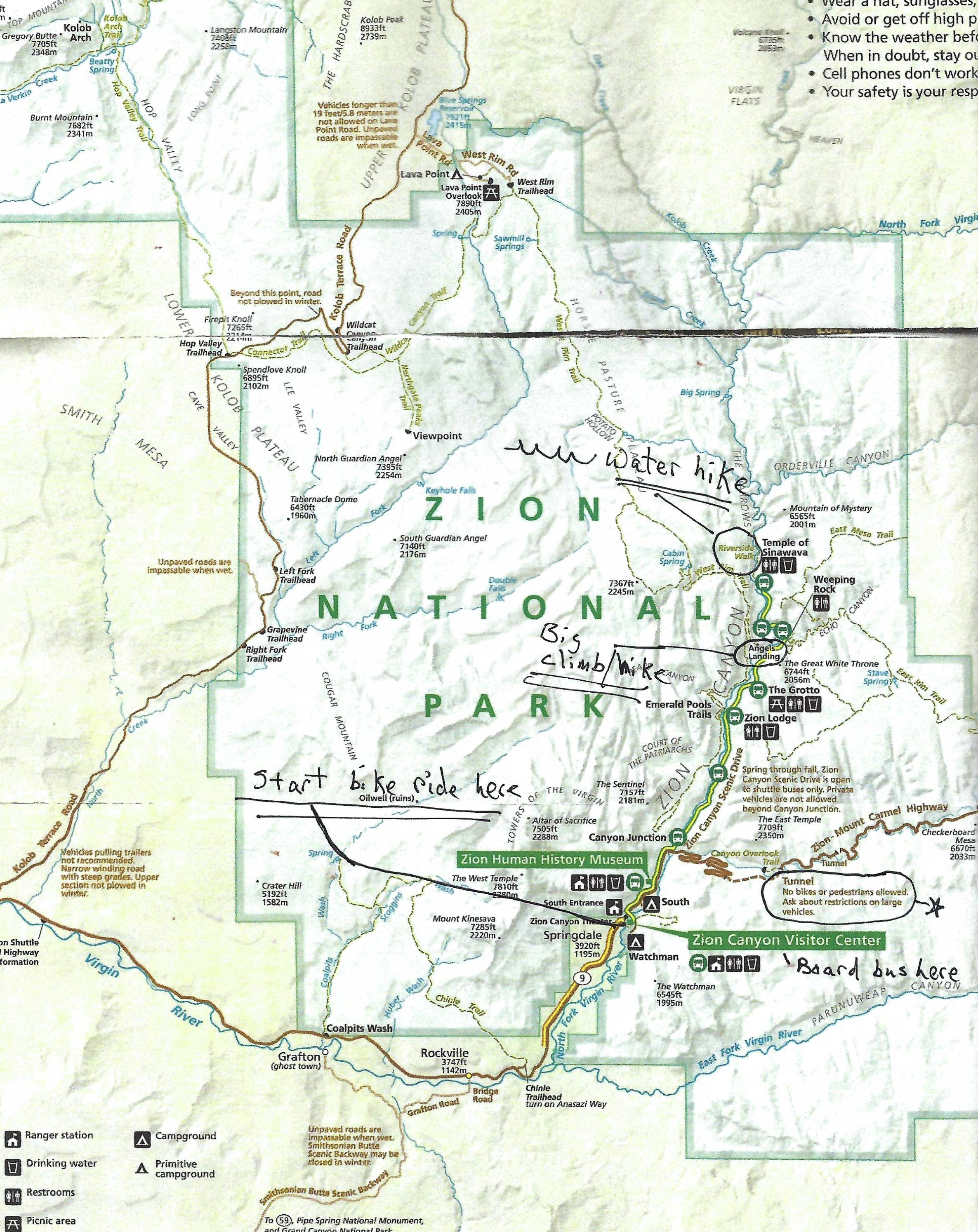
Bicycles are not allowed in the tunnel on the Zion-Mount Carmel Highway, but there is a fine place for bike riders in the Zion National Park: A paved highway with no cars allowed. The only motorized vehicle bike riders will see are buses bringing in hundreds of tourists who may hop out to hike on various trails or just sit back in their bus seat and make that their visit to the park.

Here are the rules for the buses and bicycles: Bikes can’t pass buses. A bus will pass bicycles when the rider has stopped and has his or her feet on the ground, which is required when a bus is behind you. (I only saw one pair of riders who did not follow this rule, maybe unaware of it or pursuing that day’s yellow jersey.)

We rode to the end of the road and the Temple of Sinawava trail, turned around and rode back for a pleasant 16-mile ride with no traffic on a flat paved road.

That was not enough daily exercise for this group. After changing clothes, we got in the long coiled snake of a line to get on the buses heading to the Temple of Sinawava. Many people on our crowded bus carried long wooden poles and wore black and orange shoes with gaskets around the ankles. What was that all about?

A very crowded trail

I did not find out until we got to the terrestrial ends of the Temple of Sinawava trail. That’s where the aquatic portion of the trail begins; the shoes to keep feet dry and the poles to help prevent falling as you wade up through the Narrows in the Virgin River.

The trail, both on land and sea, was crowded the day we were there, as, I bet, it is every day of the summer months. We could have avoided those crowds by getting off the bus at the start of the trail to Angels Landing. That would entail 22 switchbacks and chains to grip so you did not make a landing of your own. Anne had done the hike/climb, but it looked like I showed up 50 years too late to take this one on.

Angels Landing

Back to the Utah ride: Day 4 in Bryce Canyon

My sister arriving at Red Canyon.

This is the way to ride Bryce Canyon National Park: Put your bikes on the back of the truck and drive it to Yovimpa Point, the end of the road. There you can hike on several trails: Riggs Spring Loop Trail, Under the Rim Trail (that looks the longest) or Bristlecone Loop Trail (appears to be the shortest).

Or, you can set your bike back on the road and cruise downhill for 18 miles. The High Plains Drifter, for sure. What a downhill ride! Brakes? What brakes? I did have to slow down when I turned off on the trail at Inspiration Point. All those curves to negotiate and kids to avoid. Still made it to Ruby’s Inn a half hour before the others.

Then it was out of the park and onto a bike trail that ran along Route 12 but did venture into the woods along the way to Red Canyon where we met up with The Spouses, our excellent SAG crew.

Bikes loaded, we were off to Zion National Park, where bicycling is not allowed in the Zion-Mount Carmel Tunnel that leads to the main part of the park. Until 2026, larger vehicles – RVs, trailers, etc. – can pay a $15 charge and go through the tunnel during hours when rangers are there to orchestrate alternating one-way traffic. After 2026, larger vehicles will have to find another way into the park. The National Park Service posted this on May 30, 2024:

“Beginning in mid-2026, the park plans to reroute vehicles that exceed 11’4” tall, 7’10” wide, 35’9” long, or 50,000 pounds to routes other than the Zion-Mt. Carmel Highway (the road across Zion National Park). Vehicles that exceed these specifications can use existing alternate routes surrounding the park.”

Maybe that will make room for bicycles.

Bikes are loaded on the trucks, and we are waiting our turn for the one-way traffic through the Zion-Mount Carmel Tunnel