See the U.S.A. in a crowd, alone or how?

Choose a location, choose a book.

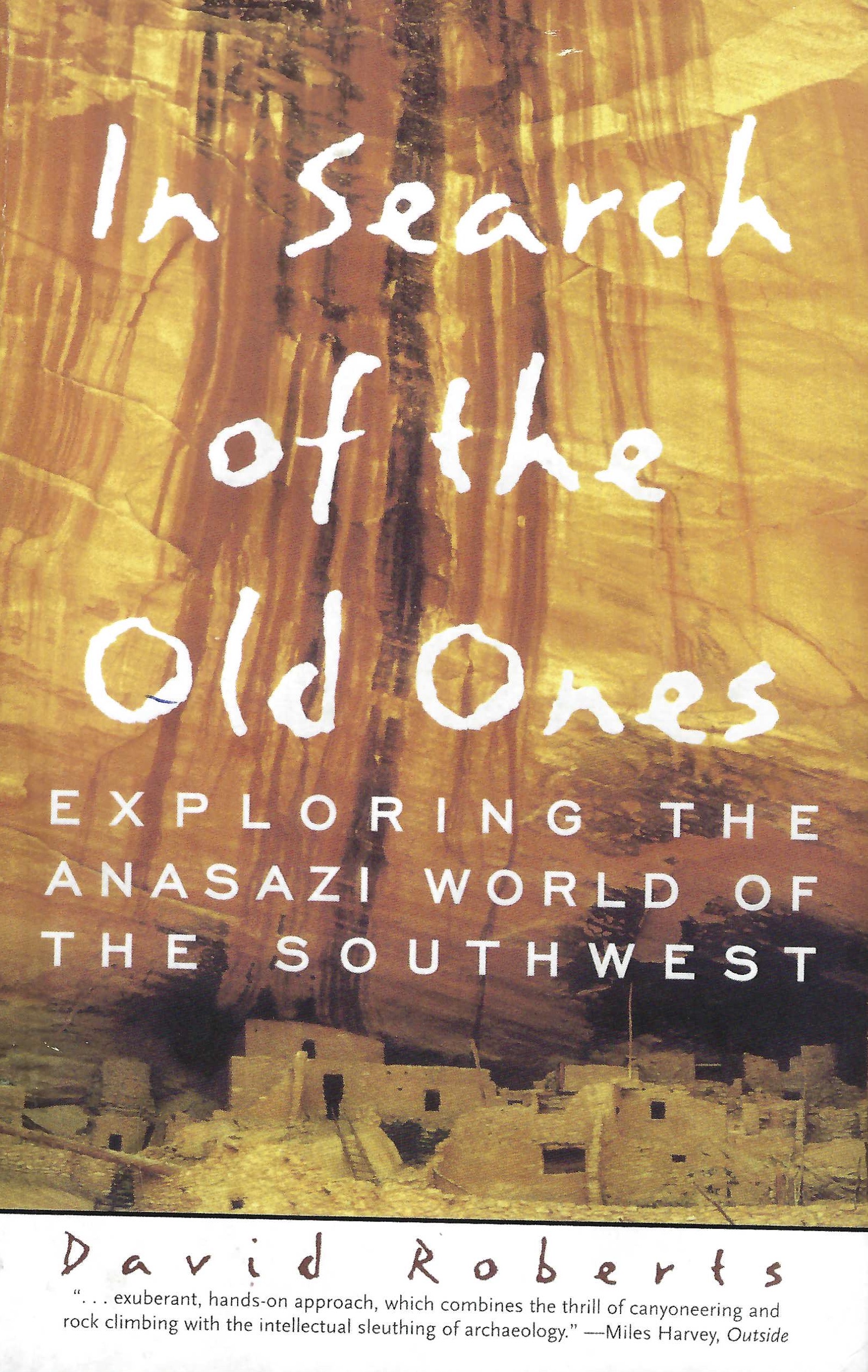
In the spring of 2024, we chose Utah, and the books I chose to read there were two by David Roberts: “In Search of the Old Ones: Exploring the Anasazi World of the Southwest” and “The Lost World of the Old Ones: Discoveries in the Ancient Southwest.”

I had read “In Search of the Old Ones” on a previous trip to Utah when I was eager to see Bears Ears National Monument before it shrank by 85 percent under a coming administration. President Biden restored it, but the shrinkage worry has resurfaced since the Nov. 5, 2024, election.

Roberts’ view of what should be protected, what should be included in a monument, may fall closer to the stance taken by Trump, President Musk’s spokesperson. Give land a name, and trouble follows. From “The Lost World of the Old Ones:”

“National parks and monuments seem inevitably to create a self-sustaining bureaucracy, and rules meant to protect a place turn into finicky and arbitrary interdictions . . .

“. . . turning BLM or National Forest Service land into a park or monument would inevitably mean multiplying the number of visitors many times over.”

If you don’t build it, no one will come. If you don’t name it a monument, fewer will come. Making it a protected public property results in more people knowing about it as they pack their bags to visit it.

Keep it low down, quiet, and Roberts will have it all to himself, or so it seems to me. But I can’t fault anyone for sharing the dream of many outsiders: How can I have this all to myself, to be alone in this beautiful spot?

But he has his limits. He’s outraged that no one protected Glen Canyon and its ancient Native American buildings from the building of a dam. He applauds those who tried to save the ancient Puebloan housings.

In the late 1950s “a gang of Southwestern archaeologists sprang into action. Like the Aswan Dam in Egypt, Lake Powell would drown hundreds of ancient sites that had never been dug or even surveyed. For eight summers, even as the waters crept slowly up the myriad side canyons of the Colorado, these scholars fanned out in a desperate effort to salvage what they could of the incalculable prehistoric heritage that would be lost forever beneath the reservoir, whose raison d’etre was to furnish power to the air conditioners and water to the swimming pools of Phoenix”

Even if Lake Powell were drained now, the adobe buildings would have melted away.

Roberts wants few restrictions or guidance on the ruins left above ground. Even the guides at parks are too much for him. His 1996 book starts with an anecdote about a Mesa Verde guide whom Roberts describes as boring, mechanical and spewing incorrect information about the Colorado ruins. That view got his books temporarily banned on some U.S. sites.

None of what Roberts says squares with what I have seen in government rangers and guides. From Civil War battlefields to other monuments and parks we have visited, our guides have been enthusiastic and willing to answer a wide range of questions. The best lecture on the Battle of the Little Bighorn came from a ranger just before we walked through the battlefield.

Our guide at Mesa Verde this summer gave a lively and well-informed talk about Cliff Palace. Yes, it was crowded, but the National Parks has limited how many people can be in the ruins at a time rather than opening to a overwhelming mob. Our guide kept the attention of her group and represented the ancient music the palace dwellers would have listened to by playing her flute.

I share Roberts’ dislike of crowds. Too many people and the site has lost its soul. If not alone, Roberts visited his ruins with a few friends or an expert that could explain the site to him.

Roberts looked for a way to visit sites between no one else being there and a multitude accompanying him. He suggested something he calls the Outdoor Museum, where visitors may discover an ancient tool or pottery shard but leave it behind “so that later visitors can earn the thrill of their own discovery.”

Sounds nice, but would it hold up to vandals, graffiti scribblers, sloppy, disrespectful visitors? I’d say, “Some protections needed, please.”

Note the filler poured on the top of this wall at the Sun Temple at Mesa Verde National Park. It is there to reinforce the wall after visitors walked on it.

Another Roberts’ way to avoid crowds is to go to some place at the end of a long, strenuous hike, climb or paddle that few will attempt. In “The Lost World,” he writes about Range Creek and Waldo Wilcox, the rancher there who protected and kept secret the ruins scattered along his family’s 12-mile spread along the creek. According to the Moon guide to Utah, the site is now protected by the state of Utah. It only allows 28 visitors a day from May 15 through November 30, can only be entered on foot or horseback, a four-wheel drive vehicle is recommended to drive to the trailhead. Or, you can hire a guide service. It seemed in keeping with Roberts’ prescription until that last phrase.

For me, I’ve come to asking, “What do you want to see and are you willing to put up with whatever it takes to see them? Suffocating crowds? Or physical activity that may be beyond me to get to ‘something even better: a place where I could still get lost; a world in which solitude seemed magical, not lonely; a tableland so vast and complex that it made a mockery of my ambition to dent it’ ”

In 2013, Roberts turned 70 and wondered, “How many more seasons like this will I have? Another ten springs and ten autumns, if I’m careful and lucky?”

He made it eight years, dying in 2021 at age 78.

With 8 billion people on the planet, finding a place to be alone becomes a more difficult ordeal. But the questions Roberts asked himself at age 70 are a reminder to stop sitting season after season, a non-activity as boring and mechanical as that Mesa Verde guide Roberts encountered. Better to figure out what you want to see, fortify yourself against what it will take to see it and go see it in the time you have left.

Keep moving, which should be a shibboleth for outdoor people such as us.


Roberts mentions the Aswan Dam and the effort to save the ancient Egyptian ruins that would have been underwater in Lake Nasser except to an effort, orchestrated by Christiane Desroches-Noblecourt, to save them. A good book on her and that effort is “Empress of the Nile” by Lynne Olson.

Post Utah bike ride: A day of rest

After five days of Utah bike riding with my sister and family, Kathy and I went south while the rest headed back to Salt Lake City. The two of us landed on the North Rim of the Grand Canyon, peering down into the Colorado River, where we rafted last fall.

You can’t see the river from where we were on the North Rim, but the views were magnificent. We had a cabin on the rim at the end of the line; no other cabin crowding us on one side.

I spent a lot of time with feet up, gazing down into the canyon.

Speaking of gazing, don’t miss the Star Party that happens on the verandah of the Grand Canyon Lodge. The signs advertising it says it starts at 7:30 p.m. Maybe for other times of the year, but we were there when it did not get dark until after 9 p.m. In the darkness, we stumbled through many telescopes set up on the verandah until we found a telescope that had no opening to look through. Instead, it streamed a picture of the sky every 10 seconds, progressively showing the stars that came out as the night went on. The operator Air Drop’d one of the photos onto our cell phones. The focus in the middle of the photo is a galaxy, which I cannot name or remember. Let’s just say it is a Galaxy Far, Far Away.

Utah bike ride, Day 5 — and a hike, too

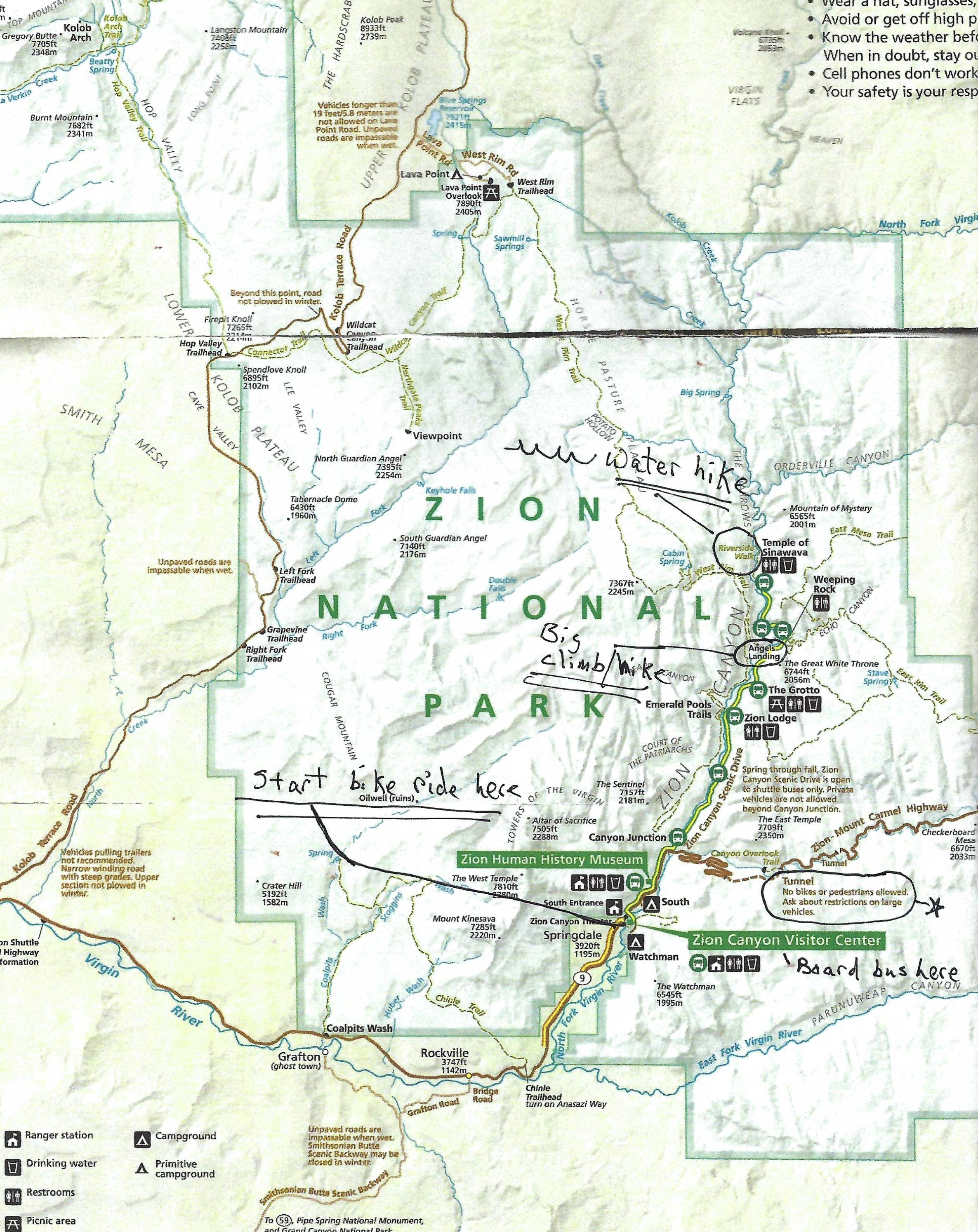
Bicycles are not allowed in the tunnel on the Zion-Mount Carmel Highway, but there is a fine place for bike riders in the Zion National Park: A paved highway with no cars allowed. The only motorized vehicle bike riders will see are buses bringing in hundreds of tourists who may hop out to hike on various trails or just sit back in their bus seat and make that their visit to the park.

Here are the rules for the buses and bicycles: Bikes can’t pass buses. A bus will pass bicycles when the rider has stopped and has his or her feet on the ground, which is required when a bus is behind you. (I only saw one pair of riders who did not follow this rule, maybe unaware of it or pursuing that day’s yellow jersey.)

We rode to the end of the road and the Temple of Sinawava trail, turned around and rode back for a pleasant 16-mile ride with no traffic on a flat paved road.

That was not enough daily exercise for this group. After changing clothes, we got in the long coiled snake of a line to get on the buses heading to the Temple of Sinawava. Many people on our crowded bus carried long wooden poles and wore black and orange shoes with gaskets around the ankles. What was that all about?

A very crowded trail

I did not find out until we got to the terrestrial ends of the Temple of Sinawava trail. That’s where the aquatic portion of the trail begins; the shoes to keep feet dry and the poles to help prevent falling as you wade up through the Narrows in the Virgin River.

The trail, both on land and sea, was crowded the day we were there, as, I bet, it is every day of the summer months. We could have avoided those crowds by getting off the bus at the start of the trail to Angels Landing. That would entail 22 switchbacks and chains to grip so you did not make a landing of your own. Anne had done the hike/climb, but it looked like I showed up 50 years too late to take this one on.

Angels Landing

Back to the Utah ride: Day 4 in Bryce Canyon

My sister arriving at Red Canyon.

This is the way to ride Bryce Canyon National Park: Put your bikes on the back of the truck and drive it to Yovimpa Point, the end of the road. There you can hike on several trails: Riggs Spring Loop Trail, Under the Rim Trail (that looks the longest) or Bristlecone Loop Trail (appears to be the shortest).

Or, you can set your bike back on the road and cruise downhill for 18 miles. The High Plains Drifter, for sure. What a downhill ride! Brakes? What brakes? I did have to slow down when I turned off on the trail at Inspiration Point. All those curves to negotiate and kids to avoid. Still made it to Ruby’s Inn a half hour before the others.

Then it was out of the park and onto a bike trail that ran along Route 12 but did venture into the woods along the way to Red Canyon where we met up with The Spouses, our excellent SAG crew.

Bikes loaded, we were off to Zion National Park, where bicycling is not allowed in the Zion-Mount Carmel Tunnel that leads to the main part of the park. Until 2026, larger vehicles – RVs, trailers, etc. – can pay a $15 charge and go through the tunnel during hours when rangers are there to orchestrate alternating one-way traffic. After 2026, larger vehicles will have to find another way into the park. The National Park Service posted this on May 30, 2024:

“Beginning in mid-2026, the park plans to reroute vehicles that exceed 11’4” tall, 7’10” wide, 35’9” long, or 50,000 pounds to routes other than the Zion-Mt. Carmel Highway (the road across Zion National Park). Vehicles that exceed these specifications can use existing alternate routes surrounding the park.”

Maybe that will make room for bicycles.

Bikes are loaded on the trucks, and we are waiting our turn for the one-way traffic through the Zion-Mount Carmel Tunnel

On with the Utah bike ride: Day 3

Day 3, Boulder, Utah, to a wide spot in the road: We faced two of the three Hs in the H-E-double LL of bike touring: Hills and head winds. Fortunately, Heat left us pretty much alone. We made 48.7 miles of the planned 66 miles.

We started with a climb up to the Hogsback, a great downhill ride with drop offs on both sides of the road, curves and lots of speed if you chose it, which I did. Another sonic boom, I’m sure.

The drop off on these shoulders is hundreds of feet

Onward to the town of Escalante, Utah, for a Gatorade and potato chip break. Anne warned us that the long downhill we had just experienced would be met with the eventual long uphill. But she forgot to mention the head winds.

More uphill

Three of us have electric-assisted bikes, and the miles they can cover on one charge is more dependent on elevation than mileage. They fell short today. My bike was down to one red bar, which doesn’t translate into anything until it starts blinking. Then it’s time to hurry to the end. My sister’s new bike said she had five miles before she was on her own, falling well short of the planned 66 miles and Tropic, Utah, and the pizza joint there, which turned out to be closed. Some wise person pulled over to a wide spot in the road and declared today’s ride over. We called in the SAG trucks, who carried us to Bryce Canyon National Park. Hooray for The Spouses!

Bryce Canyon hoodoos

A pleasant ride through Utah, thanks to Jason

“Pleasant” is not the usual word I have used to describe previous bike rides in this blog, but our recent ride in Utah was very pleasant. Organized by Jason, our niece/nephew in law, who plotted the course, found the hotels to stay in and chose restaurants to eat in. The four bike riders had wonderful SAG support, AKA “The Spouses” or Don and Kathy.

After five days of riding, Kathy and I split off to visit National Parks while the rest of the family returned to Salt Lake City. More on those National Parks in a future post, but first, the bike ride:

Fish Lake to Capital Reef Lodge, near Torrey, Utah. When I finished riding the 40-mile route, I looked at my odometer to see how long it took: 2.5 hours. Impossible. With my usual pace – even with my electric-assisted bike – of 10 miles per hour, this could not be. But lots of long, downhill coasting shortened today’s ride. My sister, who has now ridden in all lower 48 states and is migrating to Canada routes this summer, called it “the fastest I have ever ridden 40 miles.” Three of us have electric assisted bikes, and Anne, our niece, has no need for any assistance to stay up front of the pack.

Coming down the hill from Fish Lake

A quick ride tomorrow? Probably not. Jason warned us that we climb 3700 feet before the downhill into Boulder, Utah.

Torrey to Boulder, Utah: Jason was right. It was a day of climbing, up to 9,600 feet of elevation, and Jason forgot to supply oxygen bottles. But soon after that, a downhill stretch of almost 10 miles. My odometer does not record the top speed reached during a ride, a big disappointment on a day like this one where I may have broken the sound barrier. Six and eight percent downhill grades will do that.

On the long, slow way up, I kicked my electric assist up to “turbo,” the top end assistance (eco, touring and turbo) on one of the steeper hills, my first venture into turbo flight. I pedaled a few times, and the assist stopped assisting. Off my bike to investigate when engineer Anne, who the night before had passed a test online to earn her Arctic engineering credentials for Alaska, came by and prescribed the highly technical way to repair the assist: Turn it off. Turn it on. Off. On. Then it worked fine. A mystery to me for why it stopped. Shorted out? Overheated? A climb to far for Reddy Kilowatt? Thank heavens he came back to help as it would have been an unpleasant hill for me.

After the ride, I took a nap, but Kathy went off to visit a slot canyon,

(To be continued)

A blog worth visiting

My friend and former colleague Nadia is leading a group of students through Bangladesh. It’s blog worth following. Check it out at https://mjabangladesh.com/. From the blog’s introduction:

“Students from the University of Montana’s School of Journalism are traveling to Bangladesh in May 2024 to learn how climate change is affecting the world’s largest delta. We want to see what the people who have lived in this remarkable and dynamic landscape for thousands of years have to teach the rest of the world about living with change. We’ll be looking for examples of resilience and adaptation, but also to understand the losses and damages people in Bangladesh are experiencing as the global climate shifts. Bangladesh has been a leader in the movement to create a way for rich carbon polluter nations to help poorer nations that are more immediately impacted by climate change. Montana Journalism Abroad introduces Journalism students to the challenges of reporting on complex issues in other countries and creates opportunities for students to learn how to travel abroad safely and with confidence.”

Waited 5 years for this Grand Canyon trip

These are the highlights from our 15-day rafting trip on the Colorado River through the Grand Canyon.

You should take a rafting trip through the Grand Canyon with an outfitting company that sends along a string quartet, a fellow U.S. Census worker told me in 2010. That went on the to-do list immediately, but it took several years for the trip to actually happen.

First, we had to find time for it. Kathy retired in 2014. I retired, went back to work, retired again, work again, retire again and so on until 2022. But during my 2018 retirement, we thought we had time for the Grand Canyon trip. We called Canyon Explorations/Expeditions in Flagstaff, AZ, and they said they’d put us on the waiting list.

So we got on the list. No go in 2018. Not in 2019. And then COVID came around in 2020 and 2021. No go those years.

But it was on for August 16, 2022, with four friends from Montana, until I came down with COVID the week before. I spread the disease to six other family members, including Kathy, within a week. No one wanted us on a 15-day rafting trip, and I was too addled to paddle. The Montana friends went, and Canyon Explorations/Expeditions found us a spot in 2023.

And we went. I loved every minute of it, even getting dumped out of the paddle boat in the Horn Creek Rapids. Kathy does not like sleeping on the ground but braved the rapids, a rattlesnake she discovered on the way to the “Groover” (the ammunition box with a toilet seat that served as the carry-away poop spot) and bugs, scorpions and my snoring.

The guides were informative, helpful and cheerful. The food they cooked was hearty and tasty. And the string quartet . . . outstanding. Led by Steve Bryant, who plays violin in the Seattle Symphony, the quartet played for us in side canyons, and once, even as we floated down the river, our rafts tied together.

Now, we are back in Seattle, thinking about what the next trip will be.

And attending Seattle Symphony concerts.

A manga museum could save us from A.I.

Wandering back to our hotel from a countertop ramen shop in Kyoto, we came across a sign that read, “Kyoto International Manga Museum.” Finding it serendipitously surprised us since we had told the tour group arranging our trip that manga and anime topped the list of what our grandson wanted to explore in Japan. Suggestions on what to do with our free time in Kyoto mostly involved geishas, kabuki and cherry trees (not in bloom).

We followed the sign into the museum, and then manga became my top attraction in Japan. The one and most important activity in the museum is reading. On the day we were there, the museum had guest speakers talking about manga as a cultural phenomenon, but mostly visitors were there to read some of the more than 300,000 volumes of manga, which are ways of telling stories through drawings and words: graphic novels, or, some would say, comic books.

What better place to hold a museum dedicated to reading than a former elementary school. The Tatsuike Primary School opened on November 1, 1869, after the nation’s capital was moved from Kyoto to Tokyo. That brought about the threat of economic decline, but the citizens of Kyoto turned to education to stave off a downfall. The citizens around the Tatsuike school raised money to build it, taking no money from the Kyoto government.

In recent years, as people moved out of the city’s center, the student population fell from 800 in the 1950s and 1960s to 110 in 1994. Five schools were consolidated into one school in 1995, leaving the Tatsuike building vacant.

However, the school is in the central part of the city, the building is attractive and has a rich history and tradition. So, the school was converted into the Kyoto International Manga Museum “intended to serve as a new center for promoting lifelong learning through maximum use of the Museum’s functions as both a museum and library. The Museum is also expected to become a new sightseeing spot where people gather to enjoy the richness of manga culture.”

How best to tell the story of the school? Through manga, of course. Those volumes are in the museum.

At one time, manga “was misunderstood as harmful, and, at another was something people were ridiculed and thought to be stupid for reading,” says a sign introducing Aramata Hiroshi, the executive director of the museum. “But we have left those days behind us, as manga has begun to be valued as one of the coolest cultural media.”

Hiroshi, 76, worked as an assistant editor for an encyclopedia while writing an award-winning novel, “Teito Monogatatari” (Tale of the Imperial Capital). As a writer and translator, he has produced 350 books and once sought to become a manga artist. He says he has been reading manga for more than 60 years.

One guide on our trip told us that manga dates back more than a thousand years, starting with a story about a rabbit and a frog fighting each other. The unlikely winner was the frog. But he was a sumo frog. Anyone fact-checking that tale would probably find more Pinocchios than in a Trump campaign speech. This history of manga is probably more reliable.

The museum does include a few ancient drawings, but the goal of the museum is to preserve modern manga, which is still being produced in reams and reams of paper.

“This museum handles printed items (mostly magazines and books of manga) that were published from the modern age. . . . manga magazines have shaped the diversity of Japanese comics and manga is not only about stories, but also conveys knowledge and makes complicated information easily accessible thanks to their expressive devices.”

The museum’s “Hall of Fame” dates from 1912, and what is there is for people to read.

Given my love of comics (see https://madcapschemes.com/2023/03/11/as-papers-kill-comics-a-museum-is-saving-them/), finding another museum devoted to them filled my suitcases and emptied my wallet. Manga covers everything from children’s stories, adventure tales, science fiction, fantasy and non-fiction topics such as history.

History.

Told in comics.

My cup of oolong tea.

I purchased three volumes on the history of Japan from 1926 to 1989 and ordered the fourth and final volume when I got home.

“Showa: A History of Japan” refers to the era when the late Emperor Hirohito reigned, from 1926 to 1989. The author, Shigeru Mizuki (1922 – 2015) lived through that era. In the earliest days of Showa, the nationalism, militarism and extreme worship of the emperor, led to bad things for Mizuki, Japan and the world. Mizuki spent World War II on New Britain Island, now part of Papua New Guinea, where an artillery barrage took off his arm. He was not a good soldier and fell victim to the beatings common in disciplining the Japanese armed forces.

He grew up in poverty, starved during the war and returned to poverty after Japan’s defeat. The wars (World War II and the Second Japanese-Sino War from 1937 to the end of WW II) left few yens for most Japanese. But war also had a part in spreading wealth across Japan as their country was the center of resupply for both the Korean War and the Vietnam War. Those U.S. dollars helped Japan rebuild after the devastation from WW II.

Mizuki tells the Showa story in three ways: using old photos printed in stark black and white to tell the general history of international events and how Japan fit into them. He draws his own life story in cartoons and uses another of his manga creations to narrate. Nezumi Otoko (“Rat Man”) is there to introduce important personalities in Japanese politics, identifying who were the Japanese commanders in WW II battles (amazing how many committed suicide when their country was defeated – or were hanged by the Allies) and explaining the restrictive laws enforced before the war, such as the Public Security Preservation Law of 1925, under which anyone “altering the national identity” could be imprisoned (sounds like a model for DeSantis legislation). Nezumi Otoko is part of yokai, or Japanese supernatural beings such as ghost, goblins and monsters. Mizuki used them extensively in his manga, and besides, Morgan Freeman can’t narrate everything. Lots of footnotes also help.

Here’s a page from the “Showa” books that shows all three story lines, a photo of a Japanese street, Mizuki as a cartoon and the “Rat Man” lurking in the rear.

In a recent column, Maureen Dowd bemoaned the dwindling enrollment in humanities as students fled history, art, philosophy, sociology and English into the fields of tech and science.

“I find the deterioration of our language and reading skills too depressing,” she wrote. “It is a loss that will affect the level of intelligence in all American activities.”

With artificial intelligence about to let loose with all kinds of things in every activity, Dowd wonders if we will be able to deal with it “unless we cultivate and educate the non-artificial intelligence that we already possess.”

Manga might not restore the level of Americans intelligence, but it’s better than “the kinetic world of . . . phones, lured by wacky videos and filtered FOMO photos . . . flippant, shorthand tweets and texts.”

There’re words on those manga pages. Best to have a museum dedicated to reading, first manga and eventually on to “slowly unspooling novels” such as “Middlemarch” and “Ulysses.” I’m one for two on that front. One more Showa book and then, maybe, I’ll try again to meet “Stately, plump Buck Mulligan” and the rest of the Irish gang. Maybe.