Fans had to wait to celebrate Seattle Seawolves

       The Seawolves fans had to hold off their celebration until 10 minutes into the second half when Seattle took the lead for the first time, 21-20, in the Western Conference finals against Dallas. It was a short celebration as the Jackals regained the lead 20 minutes later, 25-21.

       It wasn’t until the 79th minute – the last in an 80-minute match – that the real celebration began. That’s when Seawolves fullback Divan Rossouw broke through the Dallas backline, raced toward the try line, only one tackler ahead of him when his long, accurately thrown pass connected with scrum half Ryan Rees, running in support, who touched down for the try. Conversion by Sam Windsor got Seattle back in the lead for good, 28-25.

Seawolves players and fans celebrate after winning Western Conference title. Video by Kathleen Saul

       The Seawolves, the winner of the Western Conference, will play the Eastern Conference winner, the New England Free Jacks, in San Diego’s Snapdragon Stadium on Sunday, August 4, at 1 p.m. PDT to determine Major League Rugby’s 2024 champions.

       The Free Jacks, the MLR champs in 2023, beat Old Glory DC, 33-29, and the Chicago Hounds, 23-17, in their playoff matches.

       The Dallas Jackals, 6-10 in the regular season, seemed like they might continue their “coming together at just the right time” roll through the playoffs. They beat the best in the league, Houston at 14-2, last week and stacked up a 20-14 halftime lead in Sunday’s game against Seattle. That despite being down to 13 men on the field after a double yellow card. Wing Nick Benn scored two tries, a one-handed cartwheel try in the eleventh minute and a race to finish off an overload over Seattle at 31 minutes. Both were scored in the corner, but Juan-Dee Oliver converted both and added two penalty kicks for 20 Dallas points.

       Seattle’s first score came as a penalty try after Dallas collapsed a scrum chugging toward the try line. Score: 7-10. Then a Dallas penalty kick and Benn’s second try, and the Seawolves were back down 7-20. Joe Taufete’e restored some hope for Seattle fans when he dived off a ruck to score a try under the posts. Halftime score: 14-20.

       Did the second half seem like Dallas had the ball 90 percent of the 40 minutes? And when Seattle had the ball, there were some dropped passes or ones that went behind the intended receiver or some that dribbled back to be picked up in a scramble? Seattle had two tries called back. One in the first half for a forward pass and another in the second half for a knock-on in the end zone (also known as a ball dropped when trying to touch the ball to the ground, which scores a try).

       But when things went right for Seattle, it was highlight films: JP Smith’s show and go off a ruck at the Dallas try line to plunge over for a try (now forgiving that earlier dropped ball in the try zone) and then Mack Mason’s conversion giving Seattle their first lead, 21-20, at the 50th minute.

       Dallas missed a penalty kick at the 67th minute but scored a try on a maul off their lineout. The conversion kick bounced off the upright, but Dallas had a four-point lead, 25-21, with eight minutes left in the match.

       Another upset by Dallas? Not according to Rossouw and Rees.

No penalty tries against Dallas, please

Never a question that the Seawolves would beat San Diego Legion in the first round of Major League Rugby’s Western Conference playoffs.

Seattle scored four tries (one of them a penalty try), Mack Mason connected on two penalty kicks and a conversion for 30 total team points. San Diego led early with penalty kicks by Matt Giteau, first 3-0 and then 6-3, but another PK was all the Legion could score in the first half. They never led again after that 6-3 score at 11 minutes.

Loved Seattle’s kicks ahead through the San Diego back line. First by Divan Rossouw that resulted in Duncan Matthews touching down at 13 minutes (leaving San Diego behind forever), and then another by Mason that ended in the penalty try.

Rhyno Herbst dives over for a try. Punkus Arnett photo

Smart plays by Rhyno Herbst as he dived over (some would say “like a back”) for a try at 28 minutes and the pickup by Pago Haini at the back of a ruck at 74 minutes to land a try, bringing Seattle to 30 points.

Pago Haini makes it 30. Punkus Arnett photo

Allow one question, please: What was going on at the 80th minute? A yellow card against Seattle (Seawolves had two, the Legion one) and a penalty try for San Diego, leaving them two points shy of a victory. Giteau missed a penalty kick and a conversion. Add in those lost points, and the Legion wins 33-30.

That’s the kind of gift Seattle can’t afford against Dallas, the next playoff foe (Sunday, July 28 at 1 p.m. at Starfire Stadium). The surprise of the past weekend starred the Dallas Jackals, 6-10 in the regular season, traveling to the home grounds of Houston Sabercats, with the best record in the league at 14-2, and coming away with a 34-22 win. The Texas teams played a scrappy game won by the one that could scrape together something that led to a try. Dallas did that more than Houston.

On Sunday, the Seawolves should expect a strong Dallas defense, one that mostly smothered Houston’s back line. The Dallas forwards found their way to Houston’s try zone with persistence rucking deep in Sabercats’ territory. Three of the Jackals’ five tries came off rucks within 10 yards of the goal line.

Strong forward play, Seawall defense at its best, varied back line play, no yellow cards and NO penalty tries. A Seawolves’ win against Dallas sends Seattle on to the MLR championship on Aug. 4 in San Diego.

Without a question.

Contest in flames! None for Vance; all for Biden

Winning the first 2024 madcapschemes.com political contest seemed an easy thing: Name the vice-presidential nominee paired with convicted felon Trump, and you win.

No one did.

The answers included U.S. Sen. Tim Scott from South Carolina, South Dakota Governor Kristi Noem, U.S. Congresswoman Elise Stefanik from New York, and Miami Mayor Francis Suarez.

That last guess was paired with Nikki Haley as the GOP presidential nominee What were you thinking? That campaign died like a Noem dog.

And JD Vance? Not a mention of the U.S. senator from Ohio who called Trump “American’s Hitler,” an idiot and reprehensible. Why would anyone pick him back in the day?

But Trump did.

It looked like all who named Trump, Biden and Harris would win, and the Haley devotee would contribute to charities (non-political) of our choices.

Until today. Joe Biden has stepped out of the race to win the presidency in 2024. It looks like the Biden guesses are all wrong.

There’s still a chance that Kamala Harris in the vice-presidential slot could be correct. That will depend on what happens at the Democratic National Convention, which runs from August 19 to 22.

The winner of this contest will be announced on August 23, and then we will start the next political contest.

Republished from High Country News

Project 2025’s extreme vision for the West

by Michelle Nijhuis and Erin X. Wong, High Country News
July 19, 2024

If Donald Trump is re-elected president in November, a coalition of more than 50 right-wing organizations known as Project 2025 will be ready with a plug-and-play plan for him to follow, starting with a database of potential administration appointees carefully vetted by coalition members; an online “Presidential Administration Academy” run by coalition members to school new appointees; and a 920-page policy platform called Mandate for Leadership: The Conservative Promise.

Written by former members of the Trump administration and other conservative leaders, Mandate for Leadership exhorts its readers to “go to work on Day One to deconstruct the Administrative state.” Among many other measures, it calls for radical reductions in the federal workforce and in federal environmental protections, and for advancing a “Trump-era Energy Dominance Agenda.”

Below is an overview of some of the proposals in Project 2025 that could have the greatest impact on Western land, water and wildlife — as well as on Westerners themselves.

DEPARTMENT OF INTERIOR (p. 517)

The Project 2025 recommendations for the Department of the Interior were primarily authored by attorney William Perry Pendley, a vociferous opponent of protections for public lands and wildlife. As acting director of the Bureau of Land Management during the Trump administration, he transformed the agency into what one high-level employee described as a “a ghost ship,” in which “suspicion,” “fear” and “low morale” abounded.

Energy Policy

Pendley notes that the energy section was written “in its entirety” by Kathleen Sgamma of the Western Energy Alliance, an oil and gas industry group; Dan Kish of the Institute for Energy Research, a think tank long skeptical of human-caused climate change; and Katie Tubb of The Heritage Foundation. They recommend reviving the “Trump-era Energy Dominance Agenda” by: 

  • reinstating a dozen industry-friendly orders issued by the Trump administration’s secretaries of the Interior (p. 522);
  • expanding oil and gas lease sales onshore and offshore (p. 522);
  • opening the large portions of Alaska, including the Alaska Coastal Plain and most of the National Petroleum Reserve, to oil and gas exploration and development (pp. 523, 524);
  • halting the ongoing review of the federal coal-leasing program and working “with the congressional delegations and governors of Wyoming and Montana to restart the program immediately” (p. 523);
  • restoring mining claims and oil and gas leases in the Thompson Divide of the White River National Forest in Colorado and the 10-mile buffer around Chaco Cultural Historic National Park in New Mexico. (p. 523);
  • and expanding the Willow Project, a ConocoPhillips oil-drilling operation on Alaska’s North Slope (p. 530).
As acting director of the Bureau of Land Management during the Trump Administration, William Perry Pendley visited the Casper, Wyoming, BLM field office in 2020.

Agency Operations

The project’s organizers plan to upend federal land-management agency operations by:

Land Conservation

The project aims to undo large landscape protections by:

The Cascade-Siskiyou National Monument was expanded via proclamation from President Obama in 2017, making the new monument approximately 112,000 acres.

Wildlife 

Pendley expresses particular hostility toward the U.S. Fish and Wildlife Service, whose work he described as “the product of ‘species cartels’ afflicted with group-think, confirmation bias, and a common desire to preserve the prestige, power, and appropriations of the agency that pays or employs them.” He recommends:

DEPARTMENT OF AGRICULTURE (p. 289)

The free-market advocate behind Project 2025’s section on the USDA has long railed against the subsidies and food stamp programs administered by the agency. As a fellow at The Heritage Foundation, Daren Bakst penned a lengthy report, Farms and Free Enterprise, that objects to many aspects of the farm bill, which funds annual food assistance and rural development programs. His vision, documented in the report, is present throughout Project 2025’s proposed agency overhaul.

Agency Organization

Project 2025 seeks to limit regulation in favor of market forces by:

  • reducing annual agency spending, including subsidy rates for crop insurance and additional programs that support farmers for lost crops (p. 296); 
  • removing protections for wetlands and erodible land that farmers must comply with to participate in USDA programs (p. 304); 
  • eliminating the Conservation Reserve Program, which pays farmers to enrich and protect parts of their land from agricultural production (p. 304); 
  • removing climate change and equity from the agency’s mission (p. 290, 293); 
  • and working with Congress to undo the federal labeling law, which requires consumer products to disclose where they were made and what they contain, as well as encouraging voluntary labeling (p. 307). 

Forestry

The project will reduce forests on public lands by:

Logging within the Cougar Park timber sale in Kaibab National Forest in 2018. The timber project was part of an initiative intended to treat more than 2.4 million acres of ponderosa pine forest across northern Arizona.

ENVIRONMENTAL PROTECTION AGENCY (p. 417) 

Prior to serving as the EPA’s chief of staff during the Trump administration, Mandy Gunasekara was famous for handing Republican Sen. James Inhofe a snowball to disprove the existence of human-caused climate change. At the EPA, she played a key role in the United States’ withdrawal from the Paris Agreement and in the dismantling of the Obama-era Clean Power Plan. Gunasekara’s vision for the EPA is characterized by staff layoffs, office closures and the embrace of public comment over peer-reviewed science. 

Agency Organization

The plan will diminish the agency’s scope of work by:

  • reducing full-time staff and cutting “low-value” programs (p. 422);
  • shuttering offices dedicated to environmental justice and civil rightsenforcement and complianceenvironmental educationchildren’s health and international and tribal affairs, and distributing their functions elsewhere (p. 421); 
  • eliminating all research that is not explicitly authorized by Congress (p. 436);
  • restructuring scientific advisory boards and engaging the public in ongoing scrutiny of the agency’s science — potentially opening the door to a wave of pushback against the international consensus on climate change (p. 422, 436-438);
  • eliminating the use of catastrophic climate change scenarios in drafting regulation (p. 436);
  • relocating a restructured American Indian Office to the West (p. 440);
  • partially shifting personnel from headquarters to regional offices (p. 430);
  • and striking the regulations, including a program to reduce methane and VOC emissions, that enable the EPA to work with external groups to help enforce laws (p. 424).

Natural Resources

The project would jeopardize clean air and water by:

  • limiting California’s effort to reduce air pollution from vehicles by ensuring that its standards and those of other states avoid any reference to greenhouse gas emissions or climate change (p.426);
  • supporting the reform of the Endangered Species Act to ensure a full cost-benefit analysis during pesticide approval (p. 434-435); 
  • repealing some regulations imposed by the Biden administration to limit hydrofluorocarbons, a particularly potent greenhouse gas (p. 425);
  • and undoing the expansion of the Good Neighbor Program, which requires states to reduce their nitrogen oxide emissions, beyond power plants to include industrial facilities like iron and steel mills (p. 424).

This article first appeared on High Country News and is republished here under a Creative Commons license.

Post Utah bike ride: A day of rest

After five days of Utah bike riding with my sister and family, Kathy and I went south while the rest headed back to Salt Lake City. The two of us landed on the North Rim of the Grand Canyon, peering down into the Colorado River, where we rafted last fall.

You can’t see the river from where we were on the North Rim, but the views were magnificent. We had a cabin on the rim at the end of the line; no other cabin crowding us on one side.

I spent a lot of time with feet up, gazing down into the canyon.

Speaking of gazing, don’t miss the Star Party that happens on the verandah of the Grand Canyon Lodge. The signs advertising it says it starts at 7:30 p.m. Maybe for other times of the year, but we were there when it did not get dark until after 9 p.m. In the darkness, we stumbled through many telescopes set up on the verandah until we found a telescope that had no opening to look through. Instead, it streamed a picture of the sky every 10 seconds, progressively showing the stars that came out as the night went on. The operator Air Drop’d one of the photos onto our cell phones. The focus in the middle of the photo is a galaxy, which I cannot name or remember. Let’s just say it is a Galaxy Far, Far Away.

Frederick Douglass’ sobering 4th of July words

“Fellow Citizens: Pardon me, and allow me to ask, why am I called upon to speak here today? What have I or those I represent to do with your national independence? Are the great principles of political freedom and of natural justice, embodied in that Declaration of Independence, extended to us? And am I, therefore, called upon to bring our humble offering to the national altar, and to confess the benefits, and express devout gratitude for the blessings resulting from your independence to us?

“What to the American slave is your Fourth of July? I answer, a day that reveals to him more than all other days of the year, the gross injustice and cruelty to which he is the constant victim. To him your celebration is a sham, your boasted liberty an unholy license; your national greatness, swelling vanity; your sounds of rejoicing are empty and heartless; your denunciation of tyrants, brass-framed impudence; your shouts of liberty and equality, hollow mockery; your prayers and hymns, your sermons and thanksgivings, with all your religious parades and solemnity, are to him mere bombast, fraud, deception, impiety, and hypocrisy – a thin veil to cover up crimes which would disgrace a nation of savages. There is not a nation of the earth guilty of practices more shocking and bloody than are the people of these United States at this very hour.

“Go where you may, search where you will, roam through all the monarchies and despotisms of the Old World, travel through South America, search out every abuse and when you have found the last, lay your facts by the side of the everyday practices of this nation, and you will say with me that, for revolting barbarity and shameless hypocrisy, America reigns without a rival . . .”

— 1852

Utah bike ride, Day 5 — and a hike, too

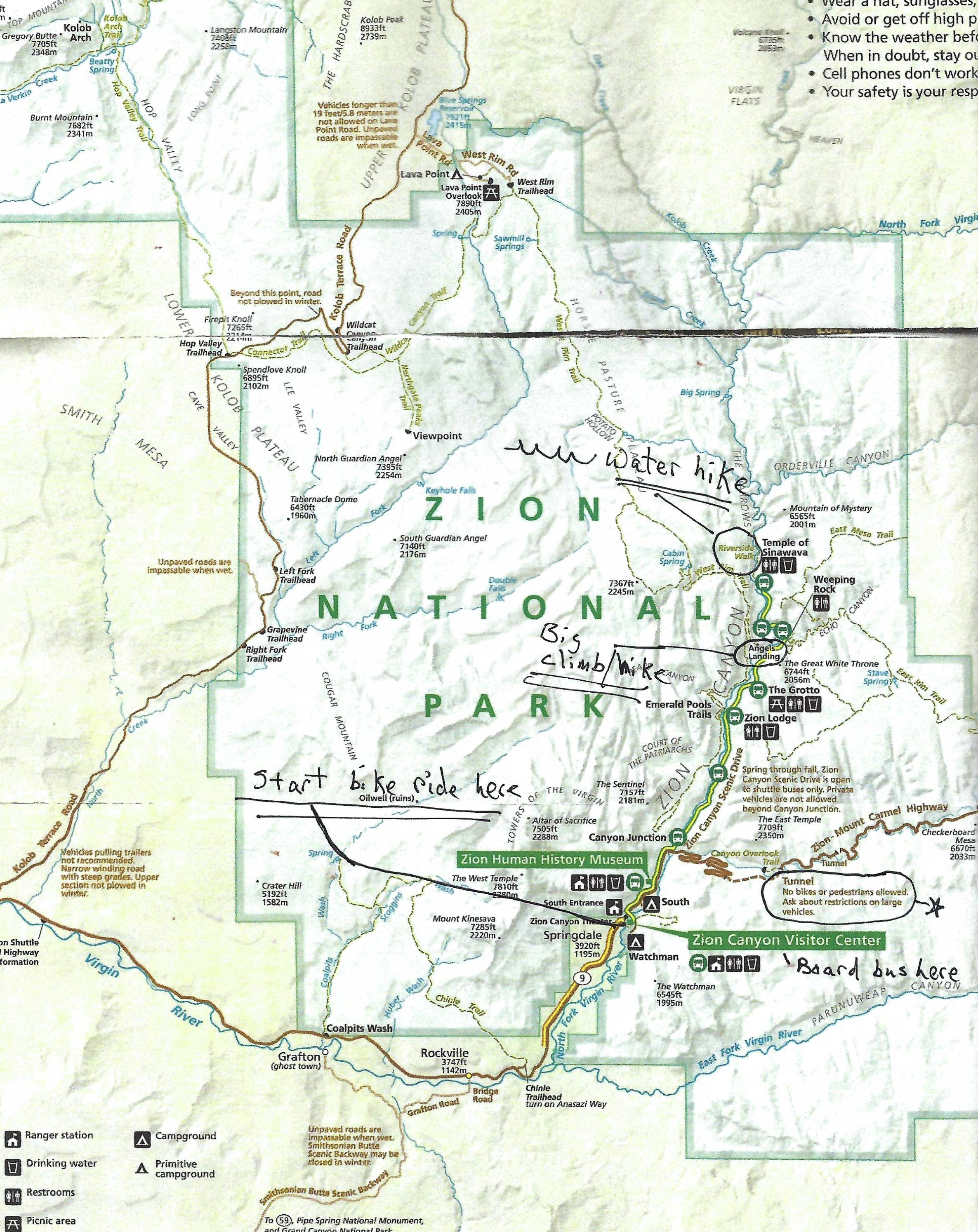
Bicycles are not allowed in the tunnel on the Zion-Mount Carmel Highway, but there is a fine place for bike riders in the Zion National Park: A paved highway with no cars allowed. The only motorized vehicle bike riders will see are buses bringing in hundreds of tourists who may hop out to hike on various trails or just sit back in their bus seat and make that their visit to the park.

Here are the rules for the buses and bicycles: Bikes can’t pass buses. A bus will pass bicycles when the rider has stopped and has his or her feet on the ground, which is required when a bus is behind you. (I only saw one pair of riders who did not follow this rule, maybe unaware of it or pursuing that day’s yellow jersey.)

We rode to the end of the road and the Temple of Sinawava trail, turned around and rode back for a pleasant 16-mile ride with no traffic on a flat paved road.

That was not enough daily exercise for this group. After changing clothes, we got in the long coiled snake of a line to get on the buses heading to the Temple of Sinawava. Many people on our crowded bus carried long wooden poles and wore black and orange shoes with gaskets around the ankles. What was that all about?

A very crowded trail

I did not find out until we got to the terrestrial ends of the Temple of Sinawava trail. That’s where the aquatic portion of the trail begins; the shoes to keep feet dry and the poles to help prevent falling as you wade up through the Narrows in the Virgin River.

The trail, both on land and sea, was crowded the day we were there, as, I bet, it is every day of the summer months. We could have avoided those crowds by getting off the bus at the start of the trail to Angels Landing. That would entail 22 switchbacks and chains to grip so you did not make a landing of your own. Anne had done the hike/climb, but it looked like I showed up 50 years too late to take this one on.

Angels Landing