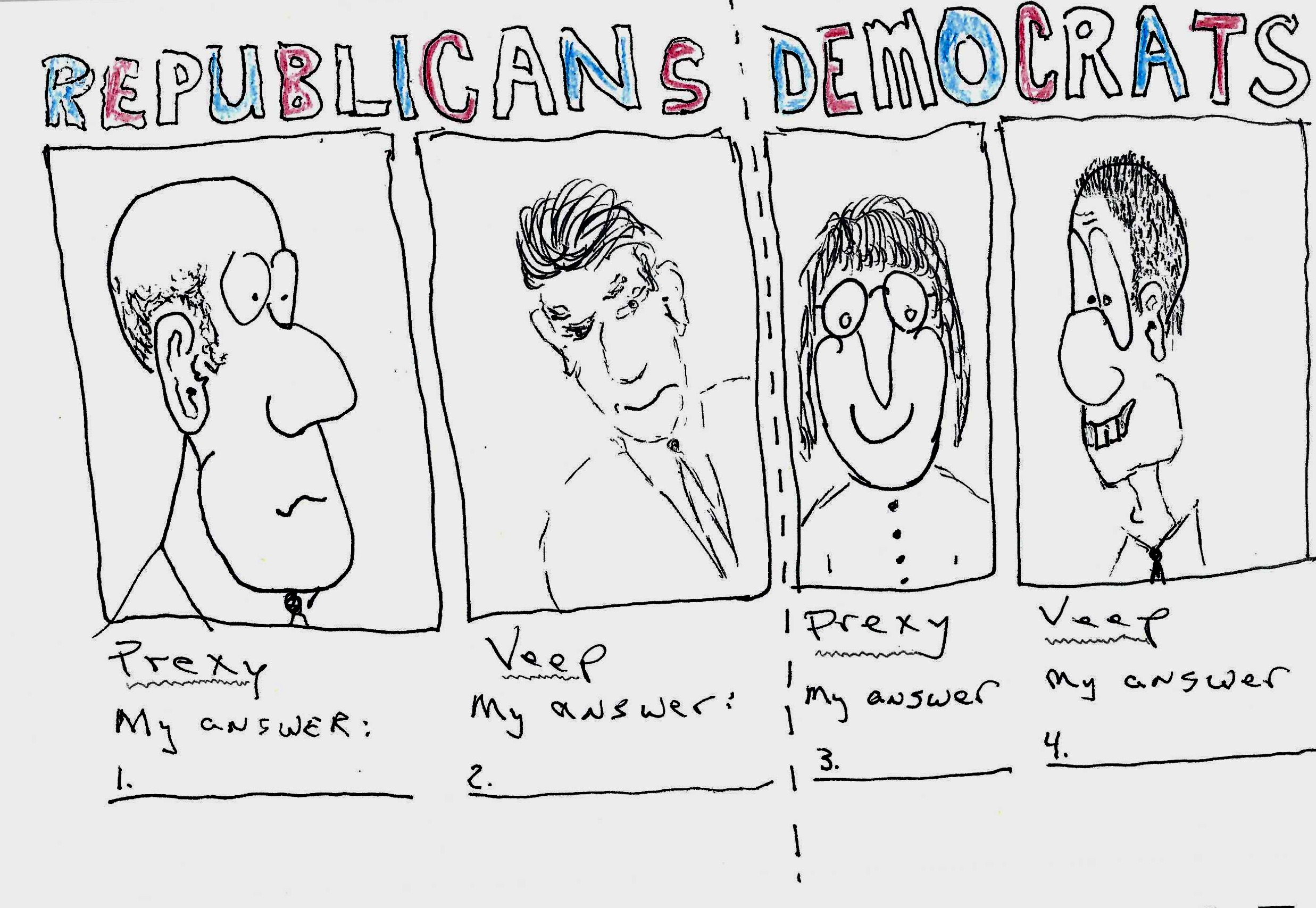
The winner of this contest will be announced on August 23, and then we will start the next political contest.
None of that is true, in keeping with the 2024 presidential election. I did not announce the winner on August 23. And I may or may not have a next political contest on this site.
But I am announcing the winners now, and they are a sorry bunch of political prognosticators. Here are the entries and their scores:
My predictions:
Trump, Tim Scott, Biden, Harris = 1 right
Can anyone beat my score of one? Here are the other entries:
2. Trump, Kristi Noem, Biden, Harris = 1 right
3. Trump, Elise Stefanik, Biden, Harris = 1 right
4. Nikki Haley, Francis Suarez, Biden, Harris = 0 right
Will the loser of entry 4 with zero right step forward? According to the rules of this contest, you will donate $100 to a charity of my choice. So please sent $100 to Operation Nightwatch.
Winning the first 2024madcapschemes.com political contest seemed an easy thing: Name the vice-presidential nominee paired with convicted felon Trump, and you win.
No one did.
The answers included U.S. Sen. Tim Scott from South Carolina, South Dakota Governor Kristi Noem, U.S. Congresswoman Elise Stefanik from New York, and Miami Mayor Francis Suarez.
That last guess was paired with Nikki Haley as the GOP presidential nominee What were you thinking? That campaign died like a Noem dog.
And JD Vance? Not a mention of the U.S. senator from Ohio who called Trump “American’s Hitler,” an idiot and reprehensible. Why would anyone pick him back in the day?
But Trump did.
It looked like all who named Trump, Biden and Harris would win, and the Haley devotee would contribute to charities (non-political) of our choices.
Until today. Joe Biden has stepped out of the race to win the presidency in 2024. It looks like the Biden guesses are all wrong.
There’s still a chance that Kamala Harris in the vice-presidential slot could be correct. That will depend on what happens at the Democratic National Convention, which runs from August 19 to 22.
The winner of this contest will be announced on August 23, and then we will start the next political contest.
Written by former members of the Trump administration and other conservative leaders, Mandate for Leadership exhorts its readers to “go to work on Day One to deconstruct the Administrative state.” Among many other measures, it calls for radical reductions in the federal workforce and in federal environmental protections, and for advancing a “Trump-era Energy Dominance Agenda.”
Below is an overview of some of the proposals in Project 2025 that could have the greatest impact on Western land, water and wildlife — as well as on Westerners themselves.
DEPARTMENT OF INTERIOR (p. 517)
The Project 2025 recommendations for the Department of the Interior were primarily authored by attorney William Perry Pendley, a vociferous opponent of protections for public lands and wildlife. As acting director of the Bureau of Land Management during the Trump administration, he transformed the agency into what one high-level employee described as a “a ghost ship,” in which “suspicion,” “fear” and “low morale” abounded.
Energy Policy
Pendley notes that the energy section was written “in its entirety” by Kathleen Sgamma of the Western Energy Alliance, an oil and gas industry group; Dan Kish of the Institute for Energy Research, a think tank long skeptical of human-caused climate change; and Katie Tubb of The Heritage Foundation. They recommend reviving the “Trump-era Energy Dominance Agenda” by:
reinstating a dozen industry-friendly orders issued by the Trump administration’s secretaries of the Interior (p. 522);
expanding oil and gas lease sales onshore and offshore (p. 522);
and expanding the Willow Project, a ConocoPhillips oil-drilling operation on Alaska’s North Slope (p. 530).
As acting director of the Bureau of Land Management during the Trump Administration, William Perry Pendley visited the Casper, Wyoming, BLM field office in 2020.
Agency Operations
The project’s organizers plan to upend federal land-management agency operations by:
and weakening the National Environmental Policy Act, which requires environmental reviews of federally funded projects, by restoring Trump-era changes that set time limits for reviews, allowed agencies to skip some reviews altogether and eliminated any consideration of a project’s climate impacts (p. 533).
Land Conservation
The project aims to undo large landscape protections by:
The Cascade-Siskiyou National Monument was expanded via proclamation from President Obama in 2017, making the new monument approximately 112,000 acres.
Wildlife
Pendley expresses particular hostility toward the U.S. Fish and Wildlife Service, whose work he described as “the product of ‘species cartels’ afflicted with group-think, confirmation bias, and a common desire to preserve the prestige, power, and appropriations of the agency that pays or employs them.” He recommends:
delisting the grizzly bear in the Greater Yellowstone and Northern Continental Divide Ecosystems (p. 534);
ending the reintroduction of “experimental populations” outside a species’ historic range (p. 534);
abolishing the Biological Resources Division of the U.S. Geological Survey — which will be difficult to do, as it no longer exists as such and is now part of the National Park Service(p. 534);
The free-market advocate behind Project 2025’s section on the USDA has long railed against the subsidies and food stamp programs administered by the agency. As a fellow at The Heritage Foundation, Daren Bakst penned a lengthy report, Farms and Free Enterprise, that objects to many aspects of the farm bill, which funds annual food assistance and rural development programs. His vision, documented in the report, is present throughout Project 2025’s proposed agency overhaul.
Agency Organization
Project 2025 seeks to limit regulation in favor of market forces by:
reducing annual agency spending, including subsidy rates for crop insurance and additional programs that support farmers for lost crops (p. 296);
eliminating the Conservation Reserve Program, which pays farmers to enrich and protect parts of their land from agricultural production (p. 304);
removing climate change and equity from the agency’s mission (p. 290, 293);
and working with Congress to undo the federal labeling law, which requires consumer products to disclose where they were made and what they contain, as well as encouraging voluntary labeling (p. 307).
Forestry
The project will reduce forests on public lands by:
and rescinding the Biden administration’s Roadless Rule for the Tongass National Forest, which preserves 9.37 million acres of the world’s largest temperate rainforest and puts a cap on logging in the region (p. 531).
Logging within the Cougar Park timber sale in Kaibab National Forest in 2018. The timber project was part of an initiative intended to treat more than 2.4 million acres of ponderosa pine forest across northern Arizona.
ENVIRONMENTAL PROTECTION AGENCY (p. 417)
Prior to serving as the EPA’s chief of staff during the Trump administration, Mandy Gunasekara was famous for handing Republican Sen. James Inhofe a snowball to disprove the existence of human-caused climate change. At the EPA, she played a key role in the United States’ withdrawal from the Paris Agreement and in the dismantling of the Obama-era Clean Power Plan. Gunasekara’s vision for the EPA is characterized by staff layoffs, office closures and the embrace of public comment over peer-reviewed science.
Agency Organization
The plan will diminish the agency’s scope of work by:
reducing full-time staff and cutting “low-value” programs (p. 422);
eliminating all research that is not explicitly authorized by Congress (p. 436);
restructuring scientific advisory boards and engaging the public in ongoing scrutiny of the agency’s science — potentially opening the door to a wave of pushback against the international consensus on climate change (p. 422, 436-438);
eliminating the use of catastrophic climate change scenarios in drafting regulation (p. 436);
relocating a restructured American Indian Office to the West (p. 440);
partially shifting personnel from headquarters to regional offices (p. 430);
and striking the regulations, including a program to reduce methane and VOC emissions, that enable the EPA to work with external groups to help enforce laws (p. 424).
Natural Resources
The project would jeopardize clean air and water by:
limiting California’s effort to reduce air pollution from vehicles by ensuring that its standards and those of other states avoid any reference to greenhouse gas emissions or climate change (p.426);
supporting the reform of the Endangered Species Act to ensure a full cost-benefit analysis during pesticide approval (p. 434-435);
repealing some regulations imposed by the Biden administration to limit hydrofluorocarbons, a particularly potent greenhouse gas (p. 425);
and undoing the expansion of the Good Neighbor Program, which requires states to reduce their nitrogen oxide emissions, beyond power plants to include industrial facilities like iron and steel mills (p. 424).
This article first appeared on High Country News and is republished here under a Creative Commons license.
This is a headline that may bring me closer to winning the first madcapschemes.com political contest of 2024, Here are the four candidates I picked:
Trump, Scott, Biden, Harris
To beat me, these entries have to do better than my picks:
Donald Trump, Kristi Noem, Joe Biden, Kamala Harris
Nikki Haley, Francis Suarez, Joe Biden, Kamala Harris
Donald Trump, Elise Stenanik, Joe Biden, Kamala Harris
If they get more right than I do, I donate to a non-political charity of their choice. If I win, they contribute to a non-political charity of my choice.
If you think your political prophecy is better than mine, then enter this charitable event. If you do better than my choices, then I contribute to a non-political charity of your choice. You lose, you contribute to a charity of my choice.
Your entries are due before 3 p.m. PST January 15, 2024, when the freeze-your-asses-off Iowa caucuses take place.
The madcapschemes winner(s) will be picked on August 22 after the Democratic Convention ends. The candidates picked then will win the contest here at madcapschemes.com. No matter what happens before Election Day (revolution, deaths, illness, I have better things to do, etc), our winner will be those candidates selected in August — no matter what happens before Election Day on Nov. 5, 2024. (We will start a new contest then.)
Anyone who beats my selections can name a charity that I will donate to. The donation amount will depend on how many entries we get. If we tie — all end up with the same selections – there will be a general call to donate to the charity you would have chosen. Amount up to you.
All “corners” welcomed here as per Maureen Dowd in The New York Times:
“… somehow social media, which was touted as an engine of connectivity, has left us disconnected and often lonely, not to mention combative. We’re all in our corners. We understand one another less than ever and have less desire to try.”
Unlike last year, when I fell short of my goal of 365 hours of exercise in a year, I clocked 368.5 hours of exercise in 2023. I reached 365 hours on Dec. 9, 2023, and then mailed in from there to the end of the year. Part of getting all those hours in 2023 can be ascribed to a busy — but unplanned — heavy travel year. We walked all over Egypt and Japan, paddled down the Colorado River and biked across Arkansas.
Adding that to weekly gym workouts and Pilates helped me make my goal, only the second time I have made 365 hours since I started the 365 Club in 2017 when I completed 383.25 hours. Since then . . . well, take a look:
2018: 349.25 hours
2019: 318 hours
2020: Missing (So bad, I did not save?)
2021: 228.5 hours (Can I blame this on COVID?)
2022: 360 hours
I can also give credit to my new electrically assisted bike, which has brought the joy of biking back into my life. Many hours on the ride across Arkansas with my sister, but I also rode it to the gym, to Pilates, to anywhere except downtown Seattle, where street car tracks and heavy traffic have scared me away. This blog got an “like” and a follower recently from another blog that is great for learning more about ebikes, everything from maintenance, laws and accessories, which they would be happy to sell you with its connection to Amazon.
Iowa caucuses are only a week away. Don’t forget the political contest here!
Before the caucuses start, send me four names that fill in these blanks:
Republican presidential nominee
Republican vice presidential nominee
Democratic presidential nominee
Democratic presidential nominee
After the political conventions this summer, we fill see if any got all four correct. If you got four and I only got three, I will donate to a charity (non-political) of your choice. If I beat you, you will contribute to a charity of my choice. Amount to be determined later.
In madcapschemes.com first political contest for 2024, you need to name the Republican and Democratic presidential and vice-presidential candidates.
So that you get no help from the American voters (ha!), your entries are due before January 15, 2024, when the Iowa caucuses take place.
The winner(s) will be picked after the GOP and the Democratic Conventions happen and the candidates are selected. The madcapscheme winners will be announced on August 22, after the Democratic Convention ends. The candidates picked then will win the contest here. Even if more tapes like the Hollywood Access one or if repaired but neglected Mac laptops are found at computer shops that should have dumped previous candidates before Election Day (but did not), our winner will be those candidates selected, not the ones on the ballot Nov. 5, 2024. No matter what happens.
Fill out your ballots and send them in a comment as a list (1. Alfred E. Neuman 2. Elmer Fudd. 3. Elmer Gantry. 4. Ramasses II). I will post mine as well. Anyone who beats my selections can name a charity that I will donate to. The donation amount will depend on corn and soybean prices, but don’t imagine anything past low three digits (maybe two if enough people beat me). If we tie — all end up with the same selections – there will be a general call to donate to the charity you would have chosen. Amount up to you.
Every article or book I have read about Egypt includes this quote from Herodotus (circa 490 — 425 BC): “Egypt is a gift of the Nile.”
So there. I have included it, too.
But I wonder if the Nile River might some day take back that gift or stop giving. Especially as Egypt and the 10 other countries that the Nile runs through “mistreat” the river.
Earliest traces of humans in Egypt go back 250,000 years, but the Nile’s gift started long after that when the climate changed and most of Egypt became a desert. Only place left to live was along the Nile. Today, 99 percent of 109 million Egyptians live on five percent of the land — along the Nile, according to a talk given to our tour group by Hany Hamroush. He has a doctorate in geochemistry from the University of Virginia, and returned to Egypt to teach at Cairo University and the American University in Cairo (AUC). His main research is on the impacts of the Nile River and the environmental changes in Egypt now and in the past.
The Nile gave Egypt river currents that flow south to north to float ships down the river and predominant winds that blow north to south to sail up the river. Trade, communications and finally a nation, a civilization. The Nile in Egypt comes from the White Nile, which starts in Lake Victoria in Uganda, and the Blue Nile, beginning in Ethiopia. Eighty-five percent of the runoff in Egypt comes from the Blue Nile, which brings with it lots of mud. Every year around June, the Nile floods in Egypt, bringing rich soil to plant crops in, water to irrigate them.
Until Jan. 15, 1971, when President Gamal Abdel Nasser opened the High Dam at Aswan.
The High Dam at Aswan with the sculpture commemorating the friendship between Egypt and the Soviet Union, who helped build the dam.
Nasser and Nikita Khrushchev, short, baldguy in the middle, at the opening of thedam.
The dam rises 366 feet above the river, is two and a quarter miles long, a half mile wide at its base with a road on top. No more silt from the Blue Nile, but many more megawatts of hydro power. As Toby Wilkinson puts it in his book “The Nile: A Journey Downriver Through Egypt’s Past and Present”:
“The High Dam has regulated the flow of the Nile, consigning the annual inundation — the natural phenomenon that built Egypt — to the history books.”
I could find no one who thought the High Dam was all good or all bad — and I admit I did very few man-on-the-street interviews while in Arabic-speaking Egypt. But in the reading I have done and the few people I talked to in Egypt, the consensus was “some good and some bad.”
Good because the dam brought about “medium floods,” as Hamroush put it. No more famines with low inundations. No more catastrophic floods like the one in 1927. The flood in 2021 was worse than the one in 1927 but not felt in Egypt because of the High Dam, said Hamroush. The dam produces about half of the electricity used in Egypt. Lake Nasser, the 300-mile-long waterway behind the High Dam, now has a productive fishery. The High Dam opened more land with year-round irrigation for agriculture.
Bad because the rich silt stops behind the High Dam. So chemical fertilizers must be used so that the country’s agriculture can feed the nation.
With the higher dam, more land cultivated, chemical fertilizers and more irrigation (think of the Nile as the only water source in Egypt — no rain, no snow pack inside the country), it sounds like agribusiness in the making. However, I looked for but only saw two tractors while in Egypt. Lots of donkeys, horses and manual labor. If Egypt can grow enough food by hand, more power to them.
Hauling alfalfa.Grain harvest along the Nile River.
More bad: Hamroush also pointed out that while silt is stuck behind the High Dam, there is less flow in the Nile so that any silt that reaches the Nile Delta doesn’t completely wash into the Mediterranean Sea. So the delta is sinking, and because of climate change, the sea is rising. The natural geological subsidence of the delta is 6.6 millimeters per year; the global sea rise is 3.3 millimeters per year. Doesn’t sound like much, but in 50 years it could affect four to eight million people, says Hamroush.
With more constant irrigation (mostly for sugar cane) there is more water damage to the foundations of ancient structures. Archeologist Kent Weeks discusses that in this video.
As Wilkerson puts it in his book: “The confident assertions of the High Dam’s cheerleaders, back in the late 1950s, now have a hollow ring. As one son of Aswan laconically put it, the High Dam ‘is slowly killing Egypt.’ “
Delivering produce to market.
And that’s not all. The Egyptians may now be paying more attention to how the Nile is treated, especially since someone else is doing the treating. Ethiopia has built and has filled the lake behind the Grand Ethiopian Renaissance Dam (GERD) on the Blue Nile. The concrete dam rises 475 feet above the river. The lake behind it covers 724 square miles (about the size of Houston, Texas). It will double Ethiopia’s output of electricity. Sounds good for Ethiopia, bad for Egypt.
For Egyptians, this could lead to ontological security—or the preservation of state identity. As this Carnegie article says:
“Ontological insecurity may arise when internal and external developments disrupt the continuity of established identities and worldviews. It could be argued, then, that the GERD project threatens the continuity of Egypt’s enacted world that sees the Nile as a living being inseparable from Egypt’s history, culture, and civilizational identity. Thus, developments related to the project could force Egypt to redefine its national identity that is centered on the Nile River.”
So the Nile could be caught between two huge dams, the High Dam in Egypt and the GERD in Ethiopia, sort of like the Colorado River in the United States, caught between Hoover and Glen Canyon Dams among others. Recently, the U.S. federal government came out with three options for how to use the water from the dwindling Colorado River, which could mean cutting off water to 10 million Americans or plugging the irrigation canals that support a “$4 billion industry that employs tens of thousands of people and puts vegetables in supermarkets across the country during the winter.”
Maybe the question more germane to the United States should be: What if the Colorado River stopped giving?
Given all that newspapers are cutting these days – reporters, editions, delivery routes and even themselves – paring away on comics might seem like something no one would miss. And then along came Dilbert, the strip’s offensive creator and the hullabaloo leading to first newspapers and then the distributing syndicate dropping Dilbert into the office trashcan.
Maybe people still do care about comics.
One place that does is on the campus of The Ohio State University, the Billy Ireland Cartoon Library and Museum. Billy Ireland (1880-1935) was a cartoonist for The Columbus Dispatch, contributing editorial cartoons and a weekly full-page feature “The Passing Show,” which commented on local figures and current events, according to a museum brochure. A gift in Ireland’s honor made the museum possible. It was founded in 1977 when OSU alumnus Milton Caniff, creator of Terry and the Pirates and Steve Canyon, donated his complete works to the university. Since then, the Columbus, Ohio, museum has grown to include:
300,000 original cartoons
45,000 books
67,000 serials and comic books
6,300 boxes of archival materials
2.5 million comic strip clippings
I visited the museum during a weekend reunion of former editors of The Lantern, the Ohio State student newspaper. Brian Basset, a former colleague at The Seattle Times and an OSU alum, was there signing books as was Derf Backderf, another OSU alum. As much as I love Red and Rover, I ended up buying a book from Backderf, mostly because I have a good friend who calls himself Derf – Fred spelled backwards. Backderf added a special signing of the book for my Derf:
Backderf has been called an illustrator who creates “cartoons with footnotes,” and his book “Kent State: Four Dead in Ohio” is very much in that vein. In fact, it is the best illustration (no pun intended) of what happened that day, the days leading up to it and what followed after the shootings.
The appearance of Basset and Backderf were a special attraction that day, but the museum has plenty to offer for anyone who takes their comics seriously. The special exhibits on the day I visited included a display on the Peanuts comic strip, loaned from the Charlies M. Schulz Museum in Santa Rosa, CA, and STILL: Racism in America, a Retrospective in Cartoons.
Let’s start with the STILL exhibit, which ended in October 2022. The name comes from calling the civil-rights movement “accomplished” with Congress passing of the civil-rights legislation in 1964. But now “with the aid of today’s technology, the truth can finally be witnessed on television screens around the world.” We could start with Rodney King, then George Floyd, Tyre Nichols and on and on. And STILL the fight continues for social justice in America. We could add a cartoonist identifying a whole segment of society as a hate group and telling other parts of society to stay away from them. STILL the fight goes on.
The exhibit featured the work of Brumsic Brandon, Jr., who created the comic strip “Luther.” Brandon called his motivation to “draw cartoons with social commentary came from his experiences of being Black in white racist society.” His daughter, Barbara Brandon-Croft, also took up cartooning, drawing “Where I’m Coming From” from 1989 until 2005.
While at the museum, I was allowed a short, escorted tour of the stacks, where they have stored all of their materials. Cartoons, comics, newspapers, etc. are being converted to digital, and the paper copies are kept in a climate-controlled environment. Here’s a video that tours the “behind the scenes:”
I was never a big fan of “Peanuts.” I was more into comics that told a continuing story, such as Steve Canyon, Steve Roper, Dondi, the Phantom and Dick Tracy. And there in the Billy Ireland Museum was Chester Gould‘s drawing desk, complete with the dark spots where the creator of Dick Tracy struck matches to help dry the ink he drew with.
It turns out that Schulz wasn’t all that fond of Peanuts either. Under the display of the first three days of Peanuts, October 2 through 4, 1950, the plaque tells us that Schulz sold his comic to United Features Syndicate, which changed “virtually everything about the strip.” Single-panel-cartoons market was glutted, the executives decided, and they wanted a four-panel strip. Schulz’ name, “Li’l Folks” was too close to another competing strip called “Little Folks.” So they changed the name of the strip to “Peanuts” — a name Schulz always disliked.
I’m hoping that newspapers, other publications and comic book stores will keep comic strips and cartoons on their pages and on their shelves. It would be a shame if future generations had to go to a museum to see them.
I returned to the United States Holocaust Memorial Museum today to pick up where I left off, which was at the start of the main exhibit concerning the Nuremberg Trials.
I had covered the anti-semitism and how it had been around way before it became a mainstay of the Nazi party in Germany, the atrocities committed by Nazi Germany, World War II and the Allied discovery of the concentration camp. That took five hours in the museum before I had to run to catch a plane back to Seattle. That was about 20 years ago when I was in Washington, D.C., for a conference. My apologies to The Seattle Times, who sent me there, that I can remember almost nothing about the conference besides visiting with others there who had previously worked at The Times and where I left off at the Holocaust museum.
So Kathy, who had not been at the museum before, started at the beginning of the main exhibit while I headed straight for the Nuremberg Trials. But I did stop and view the videos on America and the Holocaust, which I don’t remember being there in my previous visit. The videos looked back on what Americans knew about the persecution of Jews by Germans in Europe and what the United States did about it – not much.
There was another exhibit downstairs in the museum covering the same topic in greater detail, which I returned to after viewing the Nuremberg videos and displays and lunch at the museum café. The lunch was prompted by Kathy, who texted me, “I could use a break. Woof. This is tough stuff.”
It was. Tough stuff to ignore, which is what Americans did leading into World War II. Take more refugees? No way in a country suffering the Great Depression with 25 percent of the population unemployed. If we took more refugees would Germany respond by even tougher laws against the Jews? In a country where isolationism was the current policy, who cared what they were doing in Germany and the rest of Europe?
Refugees. Immigrants. Illegal migrants. Asylum seekers. No matter what you call them, it has been a sore subject for those of us safely within the borders of the United States. Go back to the 1920s when immigration was restricted and I think you will find that there has never been a policy that suits anyone or everyone. And there is no outlook for a future policy that will solve the immigration question.
Should Venezuelans have the same leniency shown to Cuban refugees/immigrants? They are both fleeing a communist regime.
Who could deny a Ukrainian family from coming to the U.S. now? They may be the latest victims of an aggressor trying to expand its territory, just like those who tried to flee Poland, Austria and other European states as Germany took them over and tried to rid them of Jews.
We don’t have 25 percent unemployment. In fact, we only have between three and four percent unemployment, which is considered by economists as full employment. Would more immigrants open up restaurants that can’t find workers?
The action of some governors to send migrants to other places seems cruel to those put on buses and hardly helpful to those reaching out to aid them in cities far from the southern border. Maybe a way of bringing attention to the problem, but still cruel and unhelpful.
No answers here, but some familiar tones in the awful history on display at the United State Holocaust Memorial Museum.
I could not escape the museum without buying two books in the gift shop: “Nuremberg: Infamy on Trial” by Joseph E. Persico, and “In Pursuit of Justice: Examining the Evidence of the Holocaust”, a project of the United States Holocaust Memorial Museum.
And I found a movie I have to see. Who can resist Edward G. Robinson?