
“. . . it cannot be denied that the dumbness of animals is a great impediment to the refinements of intercourse*.”
— Orlando by Virginia Woolf
*as in conversation for all who think intercourse is only sexual or the name of a town in Pennsylvania.

“. . . it cannot be denied that the dumbness of animals is a great impediment to the refinements of intercourse*.”
— Orlando by Virginia Woolf
*as in conversation for all who think intercourse is only sexual or the name of a town in Pennsylvania.

“. . . the financial genius of Africa, instead of devising bank notes or the precious metals as a circulating medium, has declared that a human creature, the true embodiment of labor, is the most valuable article on earth. A man, therefore, becomes the standard of prices. A slave is a note of hand that may be discounted or pawned; he is a bill of exchange that carries himself to his destination and pays a debt, bodily; he is a tax that walks corporeally into the chieftain’s treasury. Thus, slavery is not likely to be surrendered by the (Africans) themselves as a national institution. Their social interests will continue to maintain hereditary bondage! they will send the felon and the captive to foreign barracoons; and they will sentence to domestic servitude the orphans of culprits, disorderly children, gamblers, witches, vagrants, cripples, insolvents, the deaf, the mute, the barren, and the faithless. Five-sixths of the population is in chains.”

“I returned on board to aid in stowing one hundred and eight boys and girls, the eldest of whom did not exceed fifteen years. As I crawled between decks, I could not imagine how this little army was to be packed or draw breath in a hold but twenty-two inches high! Yet the experiment was promptly made, inasmuch as it was necessary to secure them below in descending the river, in order to prevent them leaping overboard and swimming ashore. I found it impossible to adjust the whole in a sitting posture; but we made them lie down in each other’s laps, like sardines in a can, and in this way obtained space for the entire cargo. Strange to tell, when the (boat) reached Havana, but three of these ‘passengers’ had paid the debt of nature.”

“Slaves were scarce, and by 1819, prime field hands were selling for $1100 in the markets of New Orleans. Even in Cuba, the paradise of smugglers, they brought $350. On the Guinea coast they could be purchased for a few yards of cloth, a keg of gunpowder, and a cask of rum – for goods, that is, worth $25 to $50. It was an old axiom of the British excise men that no trade could be prohibited when its profits were more than thirty per cent. The profits of a successful slaving voyage were a hundred and fifty, two hundred, two hundred and fifty per cent.”
When reading, I often come across sayings, adages, well-turned phrases that I might write down in a notebook or forget within 20 minutes. The forgetting I can’t help, but the stuff written down should get better play – as in sharing them.
So I have decided to put them on this blog, maybe on a daily basis. Why not dump them here all at once? Because I like the idea of a “mailbox surprise.” Maybe that comes from living on Rural Route #1 with a mailbox just across the road. Who knew what might show up there after the mail man had driven by, sitting in the middle of his front seat, left hand on the steering wheel and right hand reaching to the mailbox (before mail-delivery trucks with right hand steering)?
Same with daily comics in the newspapers that eked out one piece of the plot daily. Whatever happened to Dick Tracy, Steve Roper, Dondi, Terry and the Pirates and finally, Prince Valiant? Once the prince and Aleta were dropped from my daily newspaper, I stopped reading comics (except for “Shoe.”)
So this will be like Orlando in Virginia Woolf’s book where “whenever anything popped violently into her head, she went straight to the nearest telegraph office and wired” it to her husband. But I won’t drop into a cypher language or sign it “Rattigan Glumphoboo” as she did to keep the telegraph clerk from being any wiser. (That’s a better alias than the ones I have been using.)
The first “anything that popped into my head” came from a Zoom class Kathy and I are taking. Seemed to fit the moment:

“If we are to have another contest in the near future of our national existence, I predict that the dividing line will not be Mason’s and Dixon’s, but between patriotism and intelligence on one side, and superstition, ambition, and ignorance on the other.” Ulysses S. Grant
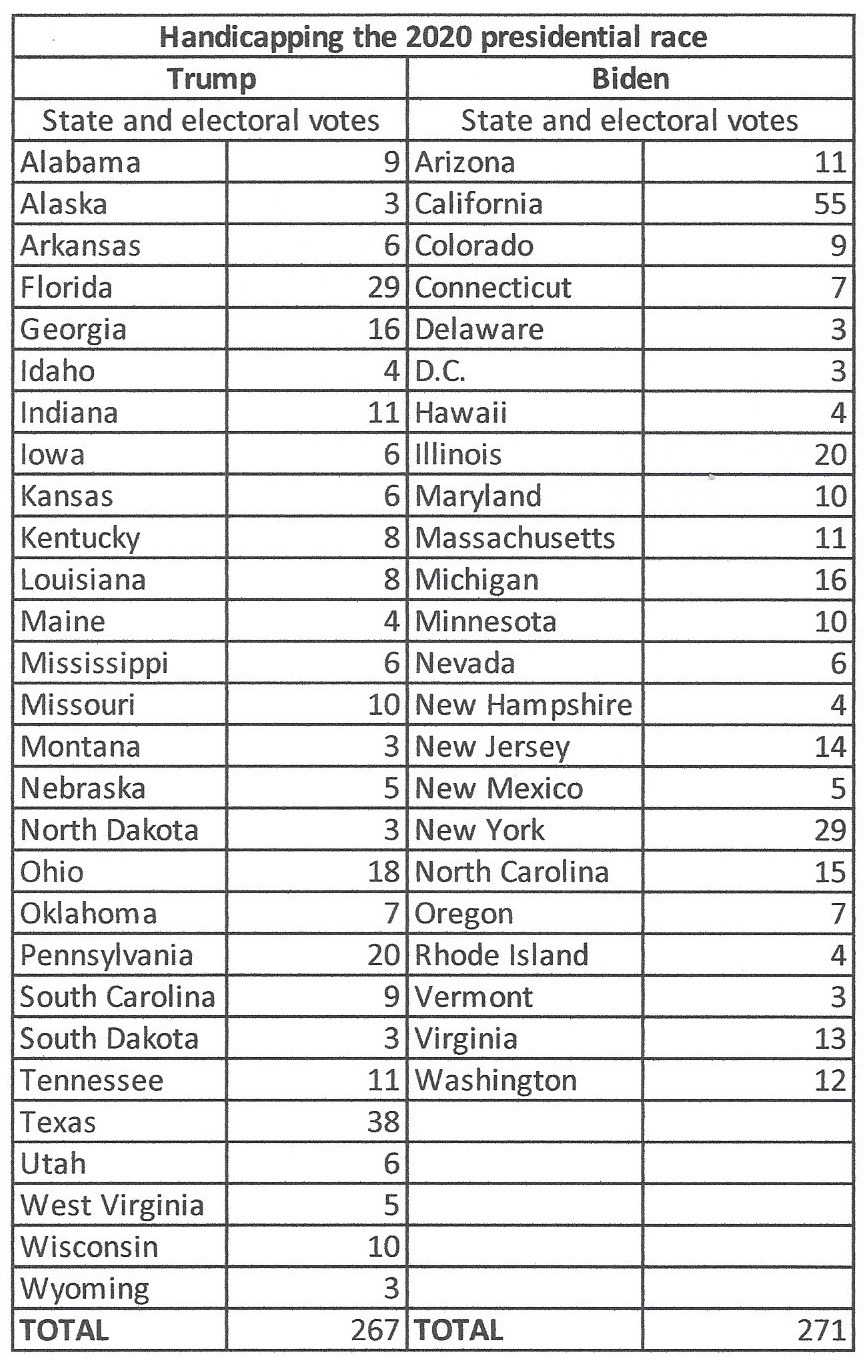
Ohio friends and family can’t understand why I am keeping the Buckeye State in the electoral vote stack for Donald Trump in my handicapping of today’s presidential vote. And it may be that I am stuck in the past.
Born there, spent my first 20 years there and I can’t get over living in a congressional district that was Republican for more than 70 years, many of the representatives from the same family. So that has influenced where I think Ohio should go politically.
But I have listened to those living in Ohio and have read this book, trying to understand Ohio, and as the title says, the rest of America:
“Barnstorming Ohio: To Understand America.”
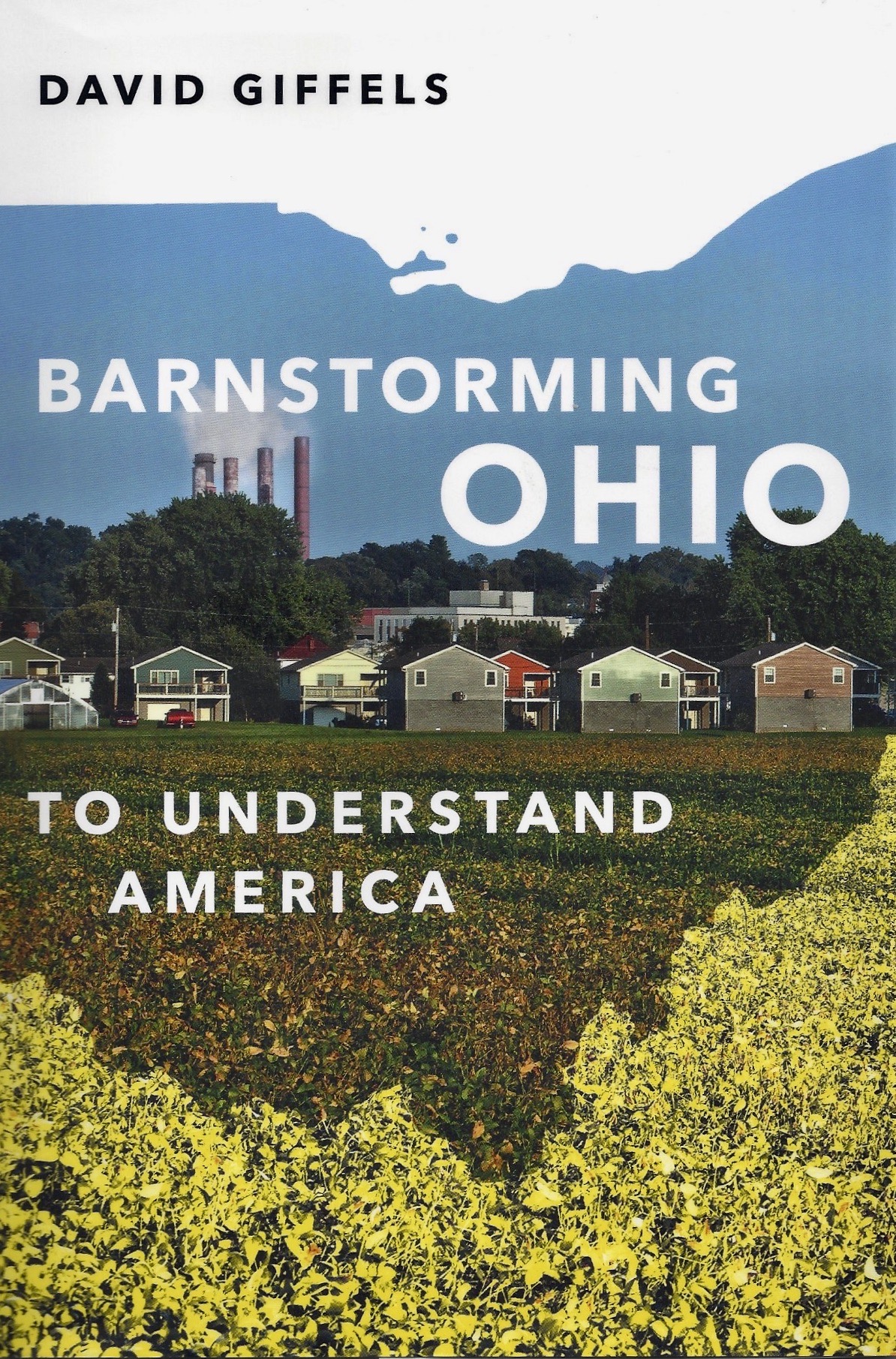
Written by David Giffels, a former columnist for the Akron Beacon Journal, the book came out this year, which might give it a short shelf life if it is only used to figure out the Trump-Biden election. But maybe people will read it to figure out what happens in the days, weeks and months ahead as we determine who won and how the nation will deal with that decision.
Giffels makes the point that you can’t ignore Ohio when trying to handicap who will win today’s election, as I have been doing the past few weeks. “Since 1896, Ohio’s voters have sided with the winner in twenty-nine of thirty-one presidential elections,” he writes. “No state has a higher percentage of accuracy. No Republican has ever won the presidency without winning Ohio. We are the only state to have a perfect record choosing the victor since 1964.”
My handicapping has Biden winning by one electoral vote (see chart below), which means I’m betting against Ohio. However, Giffels never comes down firmly for either the Democrats or the Republicans. He never says this candidate (Trump or Biden) will win. I think Giffels moves a bit toward Trump, but my final bet is on Biden to win it all despite where Ohio ends up.
As far as the second part of the book’s title — To Understand America – the book goes a long way in figuring out what we are all about in 2020. Closing auto factories in Lordstown, Ohio, even though Trump in 2017 said manufacturing jobs were “all coming back”? Reminds me of the jobs lost as Boeing shuts down operations in Washington State. Manufacturing jobs in many parts of the country aren’t coming back. That might mean a landslide against Trump. But UAW Local 1112 president David Green in Lordstown doesn’t quite see it that way. Trump will get some votes, but not “as many votes in this valley as he did then (2016), for sure.”

Soybean farmers hurt by Trump’s tariffs? Those tariffs also applied to apples, cherries and hay in Washington and to commodities grown in many states. Would a stubborn farmer abandon Trump? “I believe people in his cabinet understand the (farmers’) situation,” Giffels quotes a sixth-generation family farmer.
Malls and downtowns abandoned? That’s not just an Ohio problem, and the resurrection of downtowns — when it happens — means building what we expect America to look like, and that’s not Walmart. But will the breweries, bookstores, quaint antique shops and coffee bars replace the lost manufacturing jobs? And will Amazon come along quickly enough to buy your local empty mall and turn it into a “fulfillment center”? If enough people who fled years ago come back to run those boutique shops and Amazon warehouses, will that be enough to swing things Democratic? Or will Trump’s “law and order” litany to save downtowns keep things in his column?
Looking at all these issues, Giffels seems to find Ohio voters who chose Trump in 2016 and don’t seem likely to change their vote today. Maybe that’s because of Jim Traficant, who inured Ohio to a demagogue. The name was familiar to me as just another congressman who went to jail, but his antics might have been the ones that eased Ohio into Trump’s camp in 2016, and maybe 2020. Giffels quotes USA Today in 2016: “If Trump wins Ohio, he should thank Jim Traficant, who wrote the roadmap.” When on trial for racketeering, he offered an outlandish defense of “deny, deny, deny” what he had already confessed to that no one could believe except for the 12 men on the jury, who found him not guilty. From sheriff to congressman, “his greatest political talent was his ability to convince a marginalized constituency that he understood and cared about them in ways his opponent did not.” Later convicted on charges of racketeering, fraud, bribery and other corruption charges, he spent seven years in prison and died in 2014 when a tractor on his farm rolled over him.
All parts of America have marginalized people, but they don’t have Jim Traficant. Or they didn’t. A “Traficant” can come from anywhere, like New York City, to win an election and maybe a re-election.
Giffels never quite gets to that conclusion, no Trump wins, no Biden takes Ohio and the nation. What he does conclude is that Americans have reached a “crisis of empathy.”
“. . . whenever I talked to a Trump supporter, that person’s own certainty convinced me at least for the duration of the dialogue that he (Trump) would win a second term, and whenever I talked to an anti-Trump Ohioan, they expressed concern that I was right, even as they couldn’t conceive this happening again. To know people who voted for Donald Trump and not be able to comprehend how anyone could do such a thing is to confront the fact of our divide: a nation of people who cannot understand one another and who are losing reasons and opportunities to do so.”
A depressing place to end, but Giffels doesn’t. Instead, he turns to the buzzards at Hinckley, something I had forgotten in my 50 years outside of Ohio. Maybe they still do this, but in the 1960s, radio stations would announce when the buzzards where coming back to Hinckley, Ohio, sort of like the swallows of Capistrano. I never heard a reason for why the birds came to Hinckley and why on a certain date. Not until I read Giffels’ book. It seems that on Christmas Eve 1818, more than 500 men held a game drive, pushing all wildlife into a shrinking circle, killing 21 bears, 17 wolves, 300 deer and uncounted squirrels, turkeys, foxes, raccoons, etc. The men built fires, barbequed, bundled up some meat and went home, leaving the rest to rot. In the spring, the buzzards came, and they’ve been coming back ever since, looking for something they still believe is there.
What will we come looking for as we return in our four-year cycle? Strife that the other side won? Or will we get a start on ending our crisis of empathy? I’m not taking bets on that.
“You can’t go into Youngstown, Ohio, and tell everybody they’re going to be retrained and go work for Google or Apple. “
Michael Avenatti
For the year 2020, I proposed returning to the kind of year we had in 2015 when we spent two months in Oxford, England, visiting museums, concerts, lectures and evensongs. This year, we signed up for lectures, concerts, plays, rugby games and photo exhibitions – all of which have been canceled because of our current plague.
I all reminds me of what Daniel Defoe wrote about 1664 in “A Journal of the Plague Year:”

Thinking of their graves might have “most happily led the people to fall upon their knees, make confession of their sins, and look up to their merciful Saviour for pardon, imploring His compassion on them in surely a time of their distress.”
But no. Instead, the people turned to “extremes of folly:” conjurors, witches, mountebanks, multitudes of pills, potions, and preservatives, odious and fatal preparations, some with mercury, charms, philtres, exorcisms, amulets and certain words or figures, particularly the word Abracadabra, formed in a triangle or pyramid, thus: —

Defoe says he will not spend much time on these “follies,” but notes:

As in “worthless nonsense,” according to the Merriam-Webster Dictionary. As in synonyms like: balderdash, baloney (also boloney), beans, bilge, blah (also blah-blah), blarney, blather, blatherskite, blither, bosh, bull [slang], bunk, bunkum (or buncombe), claptrap, codswallop [British], crapola [slang], crock, drivel, drool, fiddle, fiddle-faddle, fiddlesticks, flannel [British], flapdoodle, folderol (also falderal), folly, foolishness, fudge, garbage, guff, hogwash, hokeypokey, hokum, hoodoo, hooey, horsefeathers [slang], humbug, humbuggery, jazz, malarkey (also malarky), moonshine, muck, nerts [slang], nonsense, nuts, piffle, poppycock, punk, rot, rubbish, senselessness, silliness, slush, stupidity, taradiddle (or tarradiddle), tommyrot, tosh, trash, twaddle.
Sounds about right, and who knew Defoe was a fortune teller? This will go down much easier with a little hydroxychloroquine.
(To be continued)
My friend Don suggested this as “an addition to your historical Daniel Defoe reporting:”
A LETTER FROM F. SCOTT FITZGERALD, QUARANTINED IN 1920 IN THE SOUTH OF FRANCE DURING THE SPANISH INFLUENZA OUTBREAK:
Dearest Rosemary, It was a limpid dreary day, hung as in a basket from a single dull star. I thank you for your letter. Outside, I perceive what may be a collection of fallen leaves tussling against a trash can. It rings like jazz to my ears. The streets are that empty. It seems as though the bulk of the city has retreated to their quarters, rightfully so. At this time, it seems very poignant to avoid all public spaces. Even the bars, as I told Hemingway, but to that, he punched me in the stomach, to which I asked if he had washed his hands. He hadn’t. He is much the denier, that one. Why, he considers the virus to be just influenza. I’m curious of his sources. The officials have alerted us to ensure we have a month’s worth of necessities. Zelda and I have stocked up on red wine, whiskey, rum, vermouth, absinthe, white wine, sherry, gin, and lord, if we need it, brandy. Please pray for us. You should see the square, oh, it is terrible. I weep for the damned eventualities this future brings. The long afternoons rolling forward slowly on the ever-slick bottomless highball. Z. says it’s no excuse to drink, but I just can’t seem to steady my hand. In the distance, from my brooding perch, the shoreline is cloaked in a dull haze where I can discern an unremitting penance that has been heading this way for a long, long while. And yet, amongst the cracked cloudline of an evening’s cast, I focus on a single strain of light, calling me forth to believe in a better morrow. Faithfully Yours, F. Scott Fitzgerald ~ 1920
This story, with some nice cheeky phrases, appeared in The Seattle Times this week about the “worried well” hitting the road to get out of the “germy epicenter of infections in Britain,” which would be London. Off the wealthy well went to the Lake District, Hebrides and Cornwall, where they thought they would be socially distanced only to find residents there very anti-social, as in “Go away” and quit bringing your disease here.
Same thing is also happening in the United States, where National Parks have been closed to keep people out. Residents in faraway places such as Methow Valley in Washington State are putting up Facebook warnings to keep your face elsewhere. The rich know the drill: Get an early warning of a pandemic, sell your stock and flee to your hidey-hole away from medical facilities, spreading the coronavirus as you go.
Nothing new here, as Daniel Defoe wrote in “A Journal of the Plague Year.” In 1664, when the plague hit England, the rich “thronged out of town.”

My daily check-in with TV stations to track the number of COVID-19 cases and the number of the dead reminds me of Defoe’s way of keeping track of the plague, following the parishes’ “weekly bill of mortality.”

So should Defoe’s narrator join those heading out of town? Defoe devotes many words on this decision, seeing it as directions to those who could face the same thing in the future, like in the year 2020.
 He’s a saddler, single but has a house with servants, a shop, warehouse and goods. The bills of mortality are showing 700 dead a day. But to leave, he would “hazard the loss not only of my goods, and indeed of all I had in the world.”
So he should stay, right? That lasts until his older brother shows up and tells him: “Master, save thyself.” Head for the country because “the best preparation for the plague was to run away from it.”
He takes his brother’s advice until it comes into his mind that “nothing attended us without the direction or permission of Divine Power.” Surely God “was able effectually to preserve me in the midst of all the death and danger that would surround me.”
Wait a minute, says brother.

But give me a night to sleep on it, the narrator says. But mostly what he does is read the Bible, especially the 91st Psalm, verses two through seven, which ends “there shall no evil befall thee, neither shall any plague come nigh thy dwelling.”
That might be enough reason to stick around, but two events the next day made it official: The woman who was supposed to take care of his goods fell sick, and then he did, too.
But he didn’t die as there are many, many pages to go before we sleep.
Describing coronavirus as a “foreign virus” seemed odd to me when I first heard it. Viruses seemed like part of the natural world, no nationality, no ethnicity, mostly to be avoided. But foreign? Do they carry passports? Do they salute a flag of red, white and flu? Did they ask for asylum before coming to the United States? And if so, why aren’t they in Mexico waiting for their court date?
Apparently this misguided notion of how viruses get around in this world is not unique to the coronavirus and its mis-namers. Daniel Defoe starts his “A Journal of the Plague Year” noting the same ill intention.

We have to be suspicious of Defoe and how he describes the Plague of 1664. He was only 5 years old during that year. So what he remembers or how it impressed him as a child might not hold up too well to Snopes.com. Defoe’s career as an author and journalist had elements that Trump would love: His political enemies had Defoe thrown in prison for slander. On the other hand, the two men had several things in common: They both “participated in several failing businesses, facing bankruptcy and aggressive creditors.”
Defoe wrote the “A Journal of the Plague Year” 58 years after it happened. But he must have heard stories about the plague all his life, gathered information from written sources, interviewed those who survived and wrote it as a grown man walking through the streets of London observing what it must have been like. Literary journalism at its finest.
His version of the plague strikes a chord with what is going on today. Calling the pandemic a Holland plague or a China virus exposes that you are in denial that the sickness is here now and you must deal with it. You could do that. Or, you could say things like:
“. . . We have it totally under control. It’s one person coming in from China, and we have it under control. It’s going to be just fine.”
“It will all work out well.”
“We have it very well under control. We have very little problem in this country at this moment — five. And those people are all recuperating successfully.”
“Well, we pretty much shut it down coming in from China.”
“Looks like by April, you know, in theory, when it gets a little warmer, it miraculously goes away,”
“It’s going to disappear. One day — it’s like a miracle — it will disappear.”
“I’m not concerned at all. It will go away. Just stay calm. It will go away.”
“It’s going to be just fine.”
Defoe records that those at the top in 1664 were slow to take action.

Once the plague started getting around, concealment of sickness became a general practice.
 (To be continued)
 The February Hawaii trip holds great fondness for me. Not just because of the successful whale-watching trip or the drive to Hana and around Maui on the once “forbidden-to rental-cars” road. The fondness is growing because it might be the only trip I take in this Year of the Plague.
All the time planning, getting camping permits, buying Kentucky Derby tickets, arranging hotel reservations, checking equipment for bike rides, kayak voyages and dreaming, dreaming, dreaming. About to be washed away while sheltering in place – as in staying home. And then Major League Rugby followed some of the minor sports by canceling its season. Tickets in Seattle, Atlanta and Denver, all in the trash.
I do have time to make my way through my reading list:
The Plague by Albert Camus
Love in the Time of Cholera by Gabriel Garcia Marquez
A Distant Mirror: The Calamitous 14th Century by Barbara Tuckman
And, of course, A Journal of the Plague Year by Daniel Defoe

Unfortunately, I will not be leaving these books behind on planes and in hotels as I usually do with my reading materials when traveling. When leaving the plane in Hawaii, I left behind a copy of the Ohio Farmer.  The February 2020 issue had a scary story in it about “metabolic based resistance . . . occurs once weeds develop that can convert an active ingredient into metabolites that don’t kill the plant.” In other words, weeds that we can’t kill, sort of like viruses, only bigger. The weeds “continue stacking diverse herbicide-metabolism genes into their genetics,” spelling the end of chemical control of weeds, leading to a version of Tom Russell’s question: “Who’s going to hoe those beans when the Mexicans have all gone away?”
I always leave behind a copy of The Liberty Press, so people can keep up with the Mighty Tigers, the town’s sewer and water problems and a library expansion in a town of 1,000. You never know what you might read there. Did you know that the real name of the Big Bopper (as in “Chantilly Lace”) was Jiles Perry Richardson?
Who knows what good will come of my leaving behind my copy of the Washington Thoroughbred? Someone might contact www.blueribbonfarm.com to learn the stud fee for Atta Boy Roy, a horse I always liked even though I lost money on him. How could I with a horse that had both Secretariat and Seattle Slew as great grandparents? The plane cleaner who ponies up enough money to pay the stud fee might have a horse in the Kentucky Derby that maybe, some years from now, I might see run, and probably lose money on it.
We have done one trip since Hawaii, driving halfway across Oregon to deliver a grandson to his parents who had driven up from California. With Seattle University doing online classes only, the grandson, a junior at SU, went home where the governor has ordered him and his family to stay. Which seems a long ways from the Feb. 14 issue of The Week magazine I left behind at our hotel. The headline, not a lead headline, was: “China: Is it doing enough to control the coronavirus?” Yes, said an editorial in China’s Global Times. No, said the South China Morning Post in Hong Kong. The dead: 420; infected: 20,000. We should remember Li Wenliang, the ophthalmologist who warned about the new illness, got carted away in the middle of the night by police and accused of spreading rumors. He has since died of the disease.
The Diamond Princess has just started a two-week quarantine with 2,666 guests and 1,045 crew members. Since then, more than 700 on board tested positive for the virus.
Another headline: “Coronavirus: Should you be afraid?” No, the article said, worry about the flu.
If only.
